

Company Formation Costs in South Africa
South Africa offers affordable options for company registration, with the Companies and Intellectual Property Commission (CIPC) charging R125 (£5.50) for registering a Private Company (Pty) Ltd. For those reserving a company name, the fee is an additional R50 (£2.20). The process is conducted online and typically takes 1 to 7 business days. Entrepreneurs can manage registration independently through the CIPC or opt for professional services.
Key Points:
- CIPC Costs: R125 for registration, R50 for name reservation.
- Professional Services: Packages range from R985 to R1,450 (£43–£64), offering extras like share certificates and compliance support.
- Premium Providers: International services like Platformics charge $799 (£630), bundling legal support, tax registration, and other administrative services.
- Annual Costs: Annual returns via CIPC cost between R100 and R4,000, depending on turnover.
Quick Comparison:
| Feature | CIPC (Direct) | Professional Services | Platformics |
|---|---|---|---|
| Cost | R125–R175 (£7.70) | R985–R1,450 (£43–£64) | $799 (£630) |
| Name Reservation | R50 (£2.20) | Included in packages | Included |
| Turnaround Time | 1–7 days | 2–4 days | 2–4 days |
| Extras | None | Share certificates, BEE affidavits | Legal support, tax registration |
| Administrative Help | Self-managed | Provider-managed | Provider-managed |
If you’re confident navigating compliance, CIPC is the most affordable option. However, professional services or providers like Platformics are ideal for those seeking extra support or more complex setups.
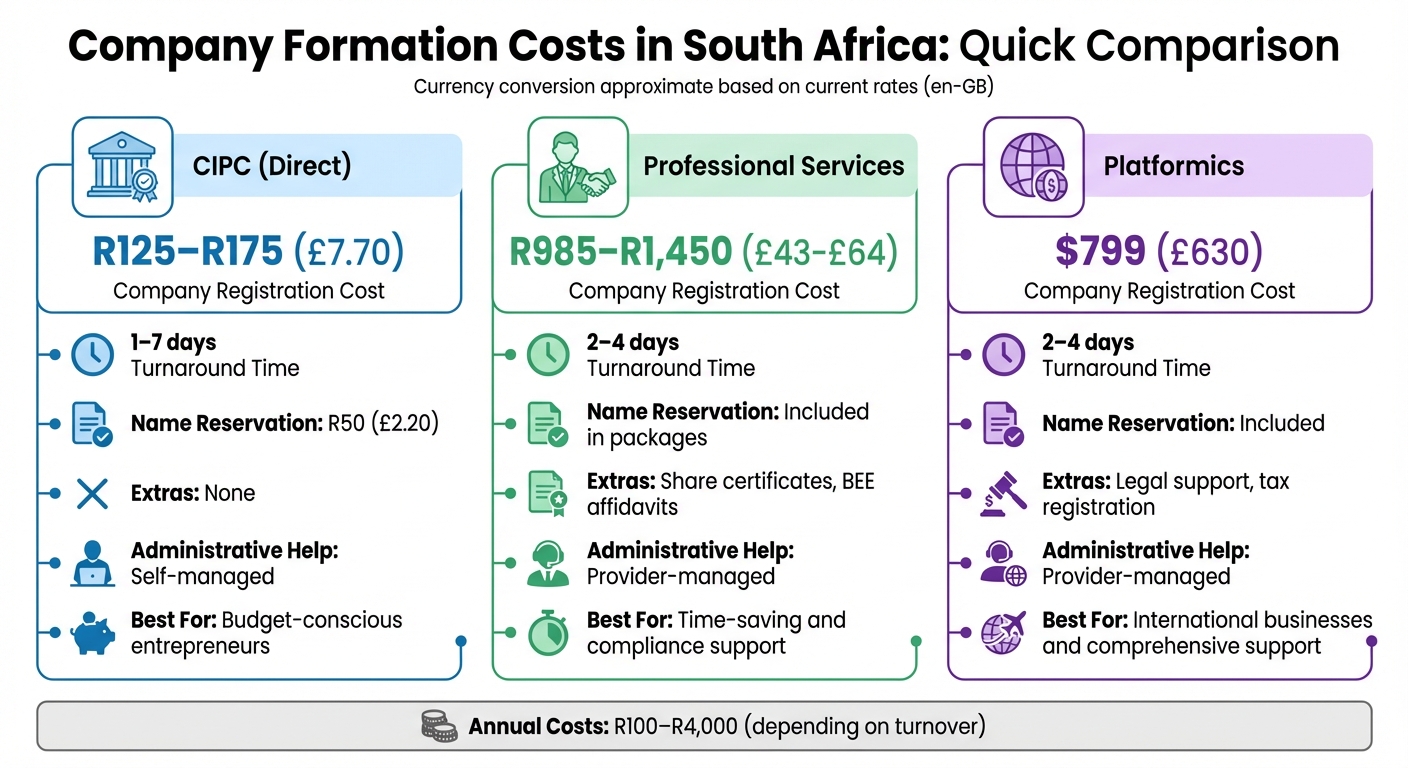
South Africa Company Formation Costs Comparison: CIPC vs Professional Services vs Platformics
1. Platformics

Cost of Registration
Platformics charges $799 (approximately £630) for company formation services in South Africa. While this is significantly higher than the basic CIPC registration fee of R125 (£5.50), the price reflects a complete incorporation package. This includes essential elements like incorporation documents, legal support, and tax registration - services that would otherwise require separate arrangements and potentially more expenses if handled directly through CIPC.
Additional Services Offered
Platformics goes beyond simple registration by offering a suite of additional services designed to ease the operational burden for businesses. For example:
- Employer of Record service: Starting at $399 (£315) per month, this covers HR administration, payroll processing, and benefits management - ideal for businesses planning to hire staff.
- Accounting services: Available from $149 (£117) monthly, these include bookkeeping, preparation of financial statements, and tax filing.
- Work permit assistance: Tailored for international entrepreneurs, this service costs $1,499 (£1,180) and helps facilitate the establishment of operations in South Africa.
These services provide a one-stop solution for companies looking to streamline compliance and administrative tasks.
Time for Completion
Platformics adheres to the standard timelines set by CIPC but offers expert support to guide businesses through each step of the process. By managing submissions via the CIPC eServices portal, the platform is particularly useful for international businesses unfamiliar with local procedures or for those who prefer professional oversight to ensure accuracy and efficiency.
Value for Money
At £630, the registration fee balances cost and convenience, offering an alternative to the bare-bones DIY route or the premium fees of specialised consultants. While registering directly with CIPC keeps initial costs low, Platformics adds value by bundling compliance support and expert guidance. This approach not only helps businesses avoid errors and missed deadlines but also simplifies vendor management for those planning to use additional services like payroll or accounting. For companies seeking an integrated solution, Platformics ensures smooth and consistent compliance across multiple business functions.
2. CIPC (Companies and Intellectual Property Commission)
Cost of Registration
Registering a private company (Pty Ltd) with the CIPC costs between R125 and R175 (around £5.50–£7.70). Additionally, a name reservation fee of R50 applies, and the minimum capitalisation required is just ZAR 1. These fees form the foundation of the various services offered by the CIPC.
Additional Services Offered
The CIPC goes beyond basic registration by offering a range of services through its BizPortal platform. During registration, businesses can also apply for B-BBEE certificates, register domain names (costing R100 to R250 annually), and handle tax and labour obligations with SARS, UIF, and COIDA. Changes to director details can be submitted online at no charge, and filings for beneficial ownership are also free.
Time for Completion
The time it takes to process registrations varies based on the method used. Private company registrations completed via BizPortal, the CIPC Mobile App, or partner banks are processed instantly. Registrations through the CIPC E-service platform typically take one working day. More complex cases, such as public companies or customised Memoranda of Incorporation, may take around five working days, while applications involving foreign nationals require an additional two days for passport verification.
Value for Money
For less than £8, the CIPC offers a straightforward and affordable option for entrepreneurs who prefer a hands-on approach to managing compliance. This fee covers essential incorporation documents and legal recognition, making it a practical choice for those confident in navigating the compliance process independently.
Guide to Company Registration in South Africa | Insights from CIPC Experts
sbb-itb-9636a59
Comparison of Costs and Services
When weighing the options between registering directly through CIPC and using professional services, the main differences come down to cost and convenience. If you're a self-sufficient entrepreneur, CIPC offers the most affordable option, charging just R175 (about £7.70) for both name reservation and registration combined. On the other hand, professional services typically charge between R985 and R1,450 (£43–£64) for their starter and essentials packages, with some consultants pricing their services as high as R3,000.
What do you get for the extra money? Professional services go beyond basic registration by including additional compliance documents. These often cover share certificates, BEE affidavits, and beneficial ownership filings - key documents that banks and clients frequently require but aren't part of CIPC's standard offering. For those seeking premium services, international providers can charge as much as US$18,180 (around £14,200) for comprehensive setups, which may include nominee directors and assistance with bank accounts.
Here’s a quick look at how the two options compare:
| Feature | CIPC (Direct) | Professional Services |
|---|---|---|
| Base Cost | R175 (£7.70) | R985–R3,000 (£43–£132) |
| Turnaround Time (business days) | 1–7 | 2–4 |
| Administrative Burden | Self-managed | Provider-managed |
| Compliance Support | Basic registration only | Often includes beneficial ownership filing |
This comparison highlights the trade-offs between a low-cost DIY route and a more comprehensive, time-saving professional package. While CIPC’s BizPortal can process instant registrations for simple cases, you’ll need to handle all document preparation and uploads yourself. In contrast, professional services manage the entire process for you, from submitting power of attorney forms to dealing with CIPC, leaving you to supply only basic company details.
For those on a tight budget and willing to invest time in understanding the system, CIPC offers excellent value. But if speed and "tender-ready" documentation are your priorities, the higher price of professional services might feel well worth it for the reduced administrative burden and broader compliance coverage.
Conclusion
Deciding between registering directly through CIPC or using professional services comes down to your budget, time availability, and confidence in handling compliance tasks. If you're working with limited funds and comfortable navigating government systems, the CIPC option is a low-cost way to handle basic registration. However, this route requires you to manage annual returns and additional registrations independently.
On the other hand, if you're looking to save time and minimise the risk of administrative mistakes, professional services are a better choice. For a slightly higher cost, these services provide end-to-end compliance support, including issuing share certificates, handling beneficial ownership filings, and tracking deadlines to avoid late filing penalties, which can range from R100 to R4,000. These documents are often essential for opening business accounts with banks.
It's important to note that failing to file two consecutive annual returns leads to automatic deregistration by the CIPC, making directors personally responsible for compliance issues. For businesses managing multiple entities or those unfamiliar with South Africa's compliance landscape, the investment in professional services often offsets the risk of costly errors.
For local entrepreneurs with simple business structures, registering directly through CIPC can be a practical choice. However, foreign investors or businesses needing customised Memorandums of Incorporation will likely benefit from professional services to navigate cross-border challenges and meet local banking requirements. Ultimately, the right option depends on aligning the service level with your operational needs and how much risk you're willing to take on.
FAQs
Why should I use professional services instead of registering my company directly with the CIPC?
Registering a company can be a straightforward process, especially when you choose the right approach. If you opt to register directly with the CIPC, it’s a cost-effective, do-it-yourself route starting at just R125. However, this option requires you to handle everything yourself - reserving a company name, preparing incorporation documents, obtaining a tax number, and ensuring compliance with regulations.
Alternatively, professional services simplify the process by managing every step for you. They handle name reservations, file all the necessary paperwork, issue your registration certificate, and secure your tax number. Many even throw in extras like a free B-BBEE affidavit. Beyond the initial setup, these services often provide ongoing support for accounting, legal compliance, and other administrative needs, all conveniently bundled into one package.
While going through the CIPC is more budget-friendly, it demands your time and effort to navigate the process. Professional services, on the other hand, offer a hassle-free experience, expertise, and ongoing support, making them an appealing option for those who value convenience.
How does Platformics make it easier to register a company in South Africa?
Platformics makes starting a company in South Africa straightforward by handling the entire process for you. Instead of juggling various government portals or wrestling with complicated paperwork, they manage everything - from reserving your company name and filing incorporation documents to obtaining a tax number and ensuring you meet local compliance requirements.
They also offer additional services like B-BBEE certification, setting up a business bank account, and ongoing compliance management. These extras save you both time and effort. With their dedicated support team and an intuitive digital dashboard, international entrepreneurs can establish their businesses in just a few days - skipping the usual administrative headaches.
What are the risks of registering a company on your own through CIPC?
Registering a company on your own through the Companies and Intellectual Property Commission (CIPC) might seem straightforward, but it carries a fair share of risks. Errors in the online application - like misspelling the company name, providing incorrect director details, or entering inaccurate share capital information - can lead to rejections. This means resubmitting paperwork, which not only delays the process but can also waste valuable time and money.
Beyond registration, CIPC mandates annual returns, with fees starting at R100 for turnovers below R1,000,000 and going up to R2,000 for larger companies. Missing these deadlines can have serious consequences, including penalties, loss of good standing, or even deregistration of your company. On top of that, CIPC’s online portal occasionally undergoes scheduled maintenance - such as from 31 March to 1 April - potentially delaying urgent submissions.
For those without a strong understanding of South African corporate law or CIPC’s procedures, the process can quickly become overwhelming. Navigating these requirements without expert knowledge often proves time-consuming and stressful, especially for businesses that are new to compliance obligations.
Related Blog Posts

Lavonne Nolan

Categories



.jpg)
