

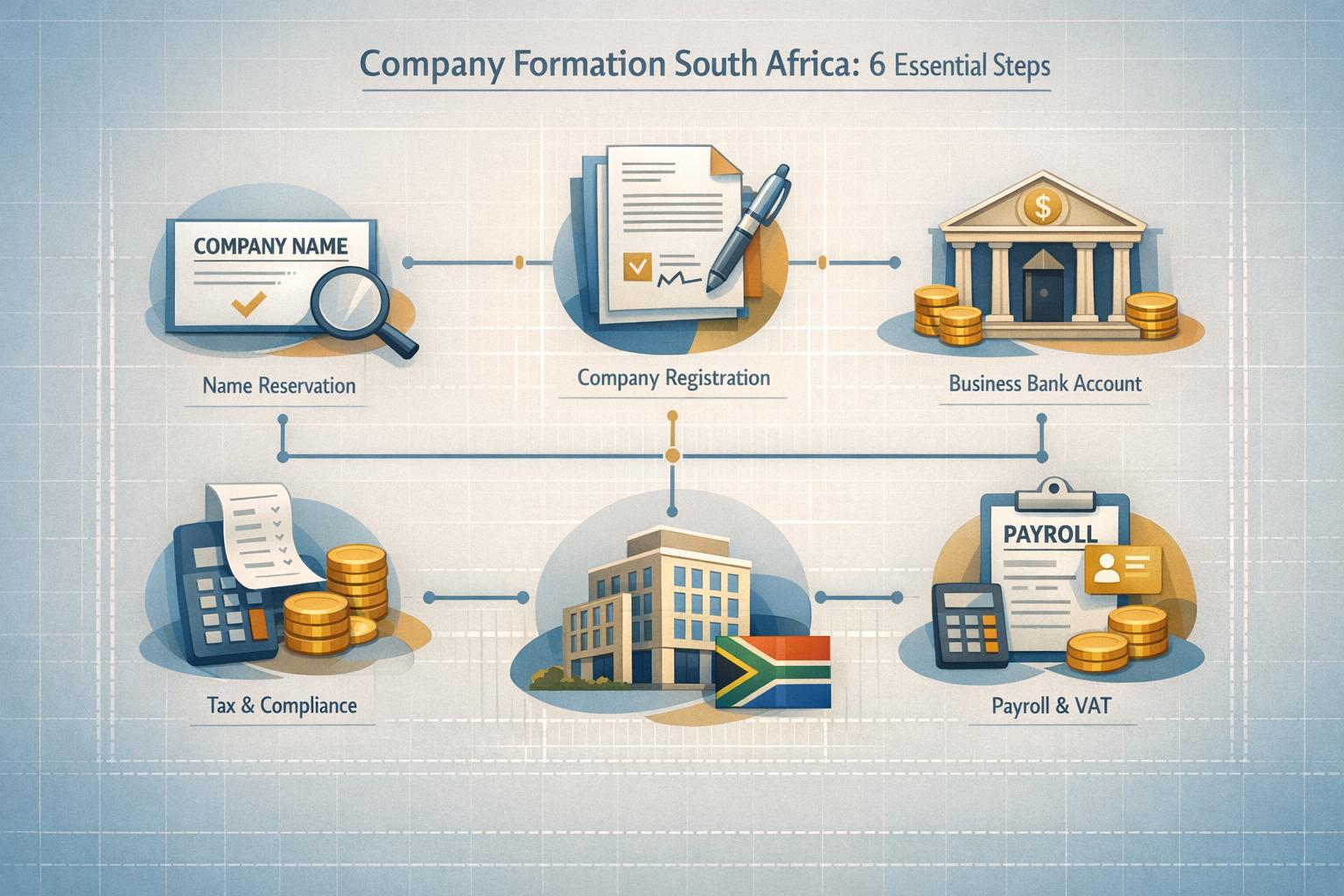
Company Formation South Africa: 6 Essential Steps
Starting a company in South Africa is easier than you might think. With a digital registration system, low fees starting at R125 (around £5.50), and automatic tax registration, the process is streamlined for both local and international entrepreneurs. Here’s a quick breakdown of the six steps to get started:
Foreign investors should also prepare for exchange control rules, B-BBEE requirements, and additional documentation for tax compliance. While straightforward, professional services like Platformics (£629 for setup) can simplify the process further. By following these steps, you can confidently establish and run your business in South Africa.

6 Steps to Register a Company in South Africa
Company Registration in South Africa – Step-by-Step Process Explained
Step 1: Choose Your Business Structure
When starting a business in South Africa, selecting the right structure is a pivotal decision. It shapes your liability, tax commitments, and compliance obligations. For international investors, the two main options are registering a Proprietary Limited (Pty Ltd) company or setting up a branch as an external company.
Business Structure Options
The Proprietary Limited (Pty Ltd) is the go-to choice for private businesses in South Africa. It operates as a separate legal entity, which means shareholders enjoy limited liability - your personal assets are safeguarded even if the business encounters financial trouble. To establish a Pty Ltd, you’ll need at least one director. The company operates under a Memorandum of Incorporation (MOI), and the registration process is relatively straightforward. Using the CIPC e-Services portal, you can register for about R125 (around £5.50), with processing times ranging from one to five days.
Alternatively, an external company registration suits businesses already incorporated abroad that want to expand into South Africa without forming a new entity. In this setup, the parent company remains fully liable for operations in South Africa, and the branch is governed by the parent company’s constitutional documents instead of a local MOI. Registration involves submitting form CoR17.1, and it typically takes three working days to complete. Regardless of the structure you choose, you’ll need a registered office address in South Africa to store official documents.
Once you’ve settled on a structure, make sure you understand and comply with the regulations governing foreign investments.
Regulatory Requirements
Foreign investors in South Africa must navigate strict exchange control rules set by the South African Reserve Bank (SARB). If you’re a non-resident buying South African shares, you’ll need exchange control approval, have your shares endorsed as "non-resident", and ensure that investments are funded through approved channels to enable repatriation of proceeds.
From 2025 onwards, banks will require proof of South African tax compliance before transferring dividends, directors’ fees, or royalties to non-residents. This proof can be in the form of a Tax Compliance Status PIN or a Manual Letter of Compliance. Unlike South African residents, who benefit from a R1 million discretionary allowance, non-residents must complete the full tax compliance process for each transfer. According to FinGlobal:
The additional documentation and waiting periods may appear daunting and could, understandably, influence the decisions of global investors.
While SARS aims to process approvals within 21 business days, delays are not uncommon.
Certain sectors impose restrictions on foreign ownership. For example, foreign control is limited to 20% in broadcasting, air services require 75% South African voting rights, banking acquisitions over 15% need approval, and mining operations must include 26%-30% B-BBEE shareholding. If you’re planning to bid for government contracts or enter regulated industries, addressing B-BBEE compliance from the start is critical.
Given these complexities, it’s wise to consult legal and tax experts early. Reaching out to banks early is also crucial, as compliance with the Financial Intelligence Centre Act (FICA) can take time and may delay your business operations. Additionally, foreign directors must complete a "Foreigner Assurance" process through CIPC e-Services to verify their passport details, which usually adds two extra working days to the registration process.
Step 2: Prepare Documents and Reserve Your Company Name
After selecting your business structure, the next step is to gather the required paperwork and secure a company name. Keep in mind that incomplete or unclear documents can lead to rejection.
Required Documents
To get started, you'll need two key documents: the Notice of Incorporation (CoR 14.1) and the Memorandum of Incorporation (MOI). For most private companies, the Short Standard Form (CoR 15.1A) is used to outline business operations. Additionally, all initial directors and incorporators must provide certified copies of their identification. South African residents should submit a green bar-coded ID or smart ID card, while non-residents need to provide their passports. Other essentials include proof of your company's registered address, director consent forms, and, if applicable, a Power of Attorney for representatives filing on your behalf.
If you're submitting documents online through CIPC e-Services, scan and email them to eServicesCoReg@cipc.co.za, ensuring the tracking number is included in the subject line. Make sure all documents are signed and dated by the incorporators before submission. For foreign directors, the "Foreigner Assurance" verification process may add around two working days to the timeline.
Once your paperwork is ready, the next step is to reserve your company name.
Company Name Registration
Reserving a company name costs R50 (approximately £2.20) and is usually processed within one working day. You can propose up to four potential names via the CIPC e-Services portal, BizPortal, or the CIPC mobile app. It's wise to submit multiple options in case your preferred name is too similar to an existing one.
Before applying, ensure your CIPC customer account has enough funds, as the system won't process your reservation without a sufficient balance. Once approved, you'll receive a CoR 9.4 (Name Reservation Certificate) via email, along with a unique tracking number. If you're reserving an existing brand name, you'll need to provide additional documentation.
That said, reserving a name is optional. If you choose not to reserve one, your registration number (e.g., 2025/123456/07) will automatically serve as your official company name until you decide to change it later. SimplyBiz Support explains:
A company may be registered with or without a company name. When a company is registered without a name, its registration number automatically becomes the company name.
Step 3: Register with CIPC and Complete Tax Registration
With your documents prepared and your company name secured, it's time to formally register your business and set up your tax profile. The process is fairly straightforward once you submit your application.
CIPC Registration Steps
You can register your business through various platforms like BizPortal (the quickest option), CIPC e-Services, the CIPC mobile app, or even through major banks such as Nedbank, ABSA, and FNB. If you choose BizPortal, your registration is usually processed immediately, while e-Services might take up to one working day. Make sure you log in using your 13-digit South African ID.
The registration fee is R125 (£5.50) for a standard private company or R175 (£7.70) if you're reserving a company name. For customised Memorandums of Incorporation (MOIs) for public companies, the cost can go up to R425 (£18.70). Once your registration is approved, you'll receive a CoR14.3 (Registration Certificate), which confirms your company's incorporation. Make sure to download the CoR14.3 and MOI immediately, as these documents are free to access for only 30 days. At this point, your company is officially registered, and you can start trading either under your registration number or your reserved name.
After securing your CoR14.3, the next step is to establish your tax profile with SARS.
SARS Tax Registration
Once your company is registered with the CIPC, SARS will automatically generate an Income Tax reference number for your business, so there's no need to apply separately for income tax registration. To manage your tax returns, register on the SARS eFiling platform.
However, VAT registration is not automatic. If your annual turnover exceeds R1 million (approximately £44,000), you are required to register for VAT within 21 business days of hitting that threshold. Alternatively, if your taxable supplies have exceeded R50,000 (about £2,200) in the past 12 months, you can opt for voluntary VAT registration. This can be done through SARS eFiling or by scheduling a virtual appointment.
Keep a close eye on your monthly revenue to ensure you don’t miss the 21-day registration deadline once you cross the R1 million turnover mark, as failing to register on time could result in penalties. For voluntary VAT registrations, the liability date is usually set to the application date, while compulsory registrations can be backdated by up to six months via SARS eFiling.
Step 4: Open a Bank Account and Set Up Financial Controls
Once your company is registered with CIPC and you’ve received your SARS tax reference number, the next step is to open a corporate bank account. Having a dedicated business account not only safeguards your limited liability status but also helps establish a clear financial history, which is crucial if you plan to apply for funding in the future.
Opening a Corporate Bank Account
To set up a corporate account in South Africa, you’ll need to provide several key documents, including your CIPC Registration Certificate (CoR 14.3) and Memorandum of Incorporation (MOI). Certified copies of identification for all directors are also required, so make sure these are ready. If any of your directors are foreign nationals, they must complete the Foreigner Assurance process. Additionally, you’ll need to supply proof of your company’s registered office address and your SARS tax number.
Banks like ABSA, FNB, and Nedbank offer streamlined processes by integrating company registration and bank account applications through their digital platforms. Once your account is set up, it’s a good idea to implement robust digital financial controls. These can include multi-factor authentication, transaction alerts, and setting daily transaction limits to enhance security. For even greater efficiency, consider using bank-integrated accounting software. These tools can automatically sync your transactions with your financial records, making bookkeeping easier and ensuring compliance with statutory requirements.
With your bank account in place, the next step is to manage international funding and ensure compliance with local regulations.
Foreign Exchange and Funding
If your business involves international funding, it’s essential to comply with the South African Reserve Bank (SARB) regulations governing cross-border transactions. For example, when transferring shareholder funding from overseas, you must adhere to SARB’s exchange control rules. Failing to secure the necessary approvals can lead to steep penalties, including administrative fines of up to 40% of the transaction value or even asset freezes.
A high-profile example occurred in July 2024, when SARB confiscated over ZAR 6 billion from Steinhoff Group entities - Steinhoff Africa Holdings, Steinhoff International Holdings, and Ibex Investment Holdings Limited. This action followed investigations into unauthorised remittances to foreign accounts.
For advance payments to foreign suppliers, you’ll typically need to present a commercial invoice before shipping. If you’re making payments after receiving goods, transport documents like a Bill of Lading or SARS Customs Declaration are usually required. Additionally, every cross-border transaction must be assigned the correct Balance of Payments (BoP) category code for SARB reporting. If you’ve previously transferred funds without proper approval, it’s crucial to approach SARB to rectify the situation and avoid hefty penalties.
For foreign-owned companies, appointing a local tax representative is another key step. This representative ensures your compliance with SARS requirements. However, finding the right person can be challenging, as they assume personal co-liability for your tax filings. Be sure to account for this in your planning and budget.
sbb-itb-9636a59
Step 5: Register for Employment and Payroll
If you're planning to hire employees, you must register as an employer within 21 business days of hiring your first staff member. This step ensures your payroll system complies with regulations and provides essential protections for your employees.
Employer Registration Requirements
You'll need to register for PAYE, UIF, and SDL. Here’s what each entails:
You can handle all registrations through the SARS eFiling platform. If your company is already registered for other tax types, use the RAV01 form (Registration, Amendments and Verification). Alternatively, you can fill out the EMP101e form for a manual application. Even if your annual payroll falls below R500,000 - the threshold for mandatory SDL payments - you still need to register and declare your relevant SETA (Sector Education and Training Authority) jurisdiction [25,26].
You’ll also need to register with the Compensation Fund (COIDA). This protects your employees in case of work-related injuries and limits your business's liability. Keeping up with COIDA payments is crucial to obtain a valid Letter of Good Standing, which is often required for South African tenders. Additionally, UIF registration is mandatory for employees working more than 24 hours per week.
Work Permits and Visas
If you plan to employ foreign nationals, make sure to understand South Africa’s immigration rules. Begin the visa and work permit process early, as the requirements and timelines can vary. Delays in securing the necessary permits could disrupt your operations.
Step 6: Maintain Compliance and Governance
Once your business is registered and set up for taxation, staying on top of compliance and governance is crucial. This involves keeping up with annual filings, tax submissions, and adhering to labour laws. Falling behind could result in penalties or even jeopardise your eligibility for tenders.
Annual Returns and Tax Filings
Every year, you must file annual returns with the CIPC to confirm that your company is still active. Missing two consecutive filings can lead to deregistration, which could leave directors personally liable for any unresolved obligations. To file these returns, you can use the CIPC BizPortal or e-Services. It's also essential to keep all statutory records updated. Note that the CIPC now requires annual financial statements to be submitted in iXBRL format, which improves financial transparency. Make sure your contact details are current, as the CIPC won’t take responsibility if deregistration notices don’t reach you due to outdated information.
For tax matters, manage all submissions via the SARS eFiling portal. When you register your company with the CIPC, SARS automatically assigns you an Income Tax reference number. However, you’ll need to manually register on eFiling to manage VAT, PAYE, and UIF. VAT registration becomes mandatory when your annual turnover exceeds R1 million. Additionally, ensure your Tax Clearance PIN is always up to date.
Compliance doesn’t stop with financial filings - it also extends to labour laws and empowerment requirements.
Labour Law and B-BBEE Requirements
To comply with labour laws, register with the Department of Labour for COID (Compensation for Occupational Injuries and Diseases). This registration allows you to obtain a Letter of Good Standing, which is often required for tenders. COID compliance protects your employees in the event of work-related injuries while limiting your business's liability.
Your B-BBEE (Broad-Based Black Economic Empowerment) status plays a significant role in securing business opportunities in South Africa. Compliance is assessed based on key priority elements, where achieving at least 40% is mandatory. Falling short of this threshold automatically reduces your B-BBEE level by one, which could impact your eligibility for contracts and supplier agreements. If your annual turnover is below R10 million, your business qualifies as an Exempted Micro Enterprise (EME). In this case, you can obtain a free B-BBEE certificate through the CIPC BizPortal, valid for 12 months.
Conclusion
Establishing a company in South Africa can be straightforward if you follow the six key steps carefully. Skipping or rushing through any of these steps can lead to serious consequences, such as automatic deregistration or fines for tax non-compliance. However, it’s worth noting that South Africa’s processes have become more streamlined over time.
One of the standout features of the system is that when you register your business with the CIPC, SARS automatically issues your Income Tax reference number. This ensures your business is recognised by the tax authorities right from the start. While the registration costs remain affordable, navigating the local regulations can still be tricky - especially for international entrepreneurs unfamiliar with South African requirements.
This is where Platformics steps in to make life easier. They offer a complete package, starting with company formation for $799 (£629) and ongoing accounting services for $149 (£117) per month. Whether it’s dealing with payroll, securing work permits, or ensuring compliance with annual returns and tax filings, their dedicated support helps you avoid costly errors and focus on growing your business. Having experts on your side can make all the difference.
Related Blog Posts

Lavonne Nolan

Categories



.jpg)
