


Reducing Overheads With Employer Of Record Services
Expanding into South Africa can be challenging due to high overheads and complex compliance requirements. Employer of Record (EOR) services simplify this process by managing payroll, HR, and legal compliance, allowing businesses to focus on growth without the costs of setting up a local entity. Here's what you need to know:
- EOR vs Local Entity Setup: Establishing a local entity can take 2–6 months and cost ZAR 50,000–ZAR 100,000 annually, while EOR services onboard employees in days with setup fees as low as £160–£400.
- Cost Savings: EORs consolidate administrative costs into a predictable monthly fee (£399/month on average), covering payroll, compliance, and HR.
- Compliance: EORs handle all legal responsibilities, including SARS filings, UIF, SDL, and employment contracts, reducing risks for companies unfamiliar with local laws.
- Flexibility: Ideal for hiring fewer than 15 employees, EORs eliminate the need for a local subsidiary, saving time and resources.
Quick Comparison
| Feature | Employer of Record (EOR) | Local Entity Setup |
|---|---|---|
| Time to Hire | Days | 2–6 Months |
| Upfront Costs | £160–£400 per employee | £3,900–£19,500 |
| Monthly Costs | £160–£1,200 per employee | High (HR, Payroll, Legal) |
| Legal Responsibility | EOR | Company |
EOR services streamline entry into South Africa's market, offering a low-risk, cost-effective alternative to traditional setups.
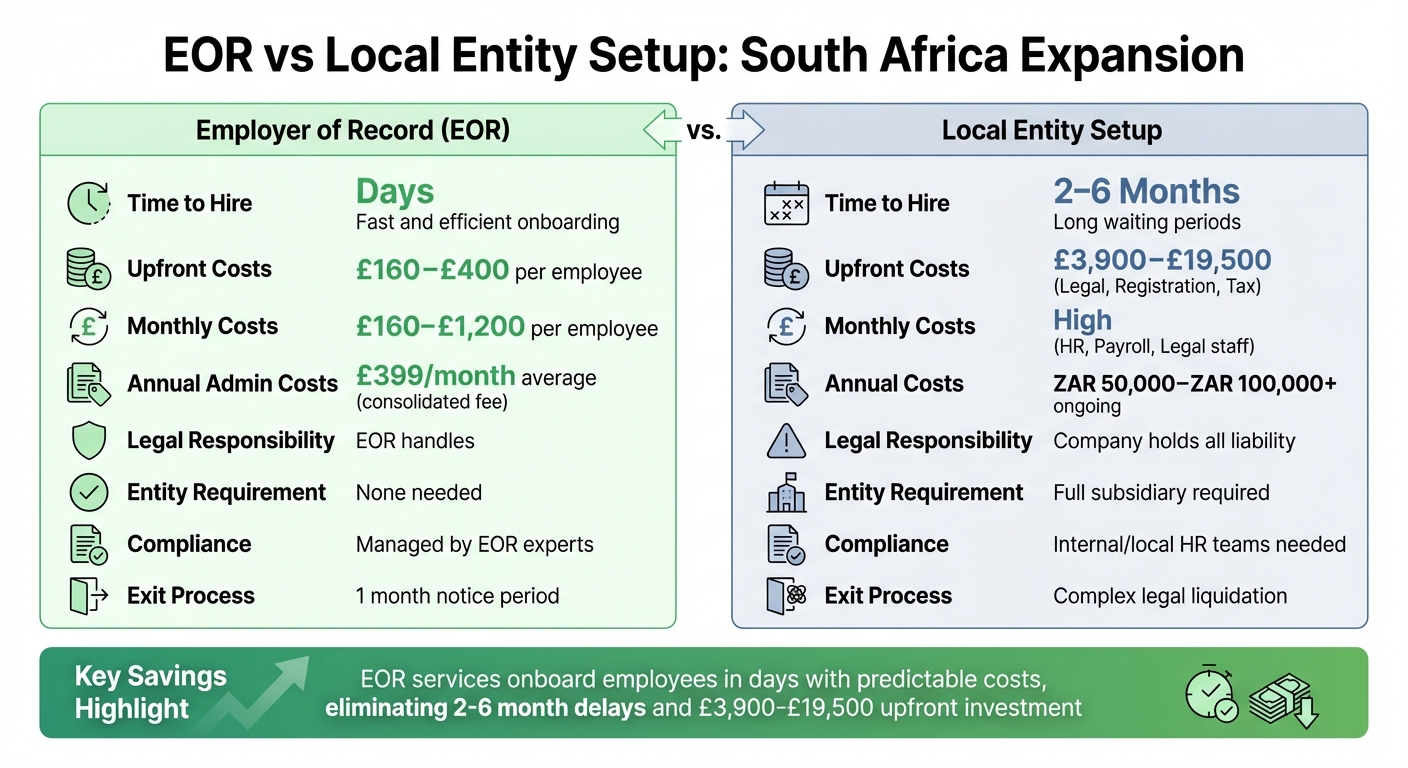
EOR vs Local Entity Setup: Cost and Time Comparison for South Africa
Employer of Record: What Are They? Why Do You Need One?
What is an Employer of Record (EOR) Service?
An Employer of Record (EOR) service offers a practical way to tackle the high costs and compliance challenges that come with hiring internationally.
In simple terms, an EOR is a third-party organisation that officially employs workers on behalf of another company. While the EOR handles HR, payroll, and legal compliance, the client company retains control over daily tasks and performance management. This setup allows businesses to sidestep the hefty costs and risks of directly employing staff. In South Africa, the EOR takes on the role of the legal employer, ensuring everything aligns with the Basic Conditions of Employment Act (BCEA) and the South African Revenue Service (SARS).
One of the key benefits of this arrangement is that it shields businesses from legal pitfalls. The EOR takes on liability for issues such as worker misclassification and compliance with South African labour laws. Amanda Masuku from CT shared her experience with this approach:
"In addition to our UK-based team, we've now been able to hire several South African employees and an Australian colleague, each with unique employment law considerations that were previously uncharted territory for us."
How EOR Services Work
The process starts with a service agreement. From there, the EOR drafts employment contracts that comply with local laws, processes payroll in South African Rand (ZAR), deducts PAYE, and manages contributions like the Unemployment Insurance Fund (UIF). The EOR also registers with local authorities, such as SARS, the Department of Employment and Labour, and relevant bargaining councils.
In South Africa, employer contributions typically include:
- 1% for UIF
- 1% for the Skills Development Levy (SDL), if the annual payroll exceeds ZAR 500,000
- Between 0.5% and 1% for the Workers' Compensation Fund
Additionally, payroll records must be kept for at least five years to comply with South African regulations.
Comparing EOR Services and Local Entity Setup
EOR services save both time and money compared to setting up a local entity. While establishing a local entity can take two to six months, an EOR can onboard employees in just a few days. Financially, the difference is also stark. Setting up a local entity comes with annual legal and registration costs ranging from ZAR 50,000 to ZAR 100,000. On the other hand, EOR setup fees are much lower, typically between £160 and £400 per employee.
| Feature | Employer of Record (EOR) | Local Entity Setup |
|---|---|---|
| Time to Hire | Days | 2–6 Months |
| Legal Responsibility | Held by the EOR | Company-held |
| Entity Requirement | None | Required |
| Upfront Cost | Low (£160–£400 setup) | High (ZAR 50,000–ZAR 100,000+) |
| Compliance | Managed by EOR experts | Managed by internal or local HR teams |
For many companies, EOR services are an ideal way to explore the South African market without the commitment of establishing a local subsidiary. This approach is especially effective when hiring fewer than 15 employees, as it keeps overheads low and makes scaling operations much easier.
How EOR Services Reduce Overheads
Tackling the overhead challenges mentioned earlier, an Employer of Record (EOR) simplifies both costs and compliance. A direct cost comparison highlights the financial benefits of using an EOR. Setting up a local entity in South Africa typically demands an upfront investment ranging from £3,900 to £19,500, covering legal, registration, and tax-related structuring. On the other hand, an EOR charges a much smaller setup fee, approximately £160 to £400 per employee. Additionally, local entities face ongoing administrative costs, while an EOR consolidates these into a predictable monthly fee, ranging from £160 to £1,200 per employee, depending on your specific needs.
| Cost Category | Local Entity Setup | EOR Managed Service |
|---|---|---|
| Upfront Investment | £3,900–£19,500 (Legal, Registration, Tax) | £160–£400 (Setup Fee) |
| Time to Hire | 2–6 Months | 1–2 Days |
| Monthly Admin Costs | High (Accounting, HR staff, Payroll) | Fixed Monthly Fee (£160–£1,200) |
| Compliance Risk | Fully on the business | Handled by the EOR provider |
| Termination/Exit | Complex legal liquidation process | Standard notice period (usually 1 month) |
Cost Savings: A Comparison
The difference in both time and financial commitment is striking. Setting up a local entity can take anywhere from two to six months, while an EOR can onboard employees in just one to two working days. This speed means your team in South Africa can start generating revenue almost immediately, without the delays caused by lengthy legal and administrative processes.
The DNA EOR Analytics Team highlights this efficiency:
"While EOR services include monthly charges, the added expense of handling compliance can be more cost-effective than setting up and maintaining a local entity."
These savings extend beyond initial costs, reducing the burden of compliance and administrative overheads, which can often be time-consuming and risky.
Compliance Management and Risk Reduction
An EOR is not just about saving money - it also significantly reduces compliance risks. By acting as the legal employer on paper, the EOR assumes full responsibility for compliance. This includes handling all necessary registrations with SARS, submitting monthly EMP201 forms for PAYE, UIF, and SDL, and ensuring annual EMP501 tax reconciliations are accurate and timely.
Jesse Weisz, R&D Analyst at Playroll, explains:
"An Employer of Record removes that risk by acting as the legal employer on your behalf, taking full responsibility for compliance, contracts, payroll, and employee benefits."
This arrangement ensures you avoid missteps in navigating South Africa’s complex labour laws while staying fully compliant.
Administrative Efficiency and Resource Focus
Outsourcing HR and payroll tasks to an EOR frees up your internal team to concentrate on your business's core activities. There’s no need to hire local HR specialists, purchase country-specific payroll software, or build expertise in managing statutory contributions like UIF, SDL, and COIDA. The EOR takes care of everything, from drafting legally compliant employment contracts to processing payroll in South African Rand and managing exchange rate fluctuations.
sbb-itb-9636a59
How Platformics EOR Services Cut Overheads

Platformics provides a comprehensive Employer of Record (EOR) solution tailored for businesses expanding into South Africa. By eliminating the need for costly entity setups and ensuring compliance with local regulations, the platform allows your team to focus on what truly matters - growing your business. From managing HR administration and payroll to handling statutory filings with SARS, Platformics takes the complexity out of navigating South Africa's regulatory landscape.
Platformics EOR Features and Benefits
Platformics simplifies employment management by consolidating all responsibilities into one predictable monthly fee. Their expertise spans payroll, statutory contributions, and the entire employee lifecycle, from onboarding to offboarding. With over 20 years of experience in HR and accounting, you gain access to seasoned support without needing to invest in internal specialists. The platform boasts a 98% customer satisfaction rate and has successfully completed over 100 projects, showcasing its reliability in the South African market.
As the legal employer, Platformics assumes full responsibility for compliance with the Basic Conditions of Employment Act and SARS regulations. This significantly reduces risks related to worker misclassification or penalties for late filings.
Pricing Structure
| Service | Price | Key Features |
|---|---|---|
| Employer of Record | £399/month | HR Administration, Payroll, Compliance, Benefits, Onboarding/Offboarding, Expert Support |
| Company Formation | £799 (One-time) | Incorporation Documents, Tax Registration, Local Address, Legal Support |
| Accounting | £99/month | Bookkeeping, Financial Statements, Tax Filing & Compliance |
For a fixed £399 monthly fee, all essential employment services are covered, offering transparent and predictable costs. This structure makes it easier to scale your team in South Africa without worrying about unexpected expenses.
These pricing options not only help businesses reduce overheads but also position them to take full advantage of South Africa's growing market potential.
Accessing South Africa's Market Advantages
With Platformics, you can tap into a workforce of 19 million English speakers and benefit from payroll tax rates as low as 2–5%, compared to Europe's 20–30%+. The platform enables operational readiness in just days, bypassing the typical 2–6 month setup period. South Africa's GMT+2 time zone aligns seamlessly with European business hours, allowing for real-time collaboration without the added costs of staggered shifts. As a gateway to over one billion consumers across Africa, South Africa presents significant growth opportunities, and Platformics ensures you can seize these with minimal overhead investment.
Conclusion: Scaling with EOR Services
Expanding into South Africa no longer requires the hassle and expense of setting up a local entity. Employer of Record (EOR) services simplify the process, handling the complexities of local labour laws while granting businesses instant access to a large, English-speaking talent pool. By bundling payroll, compliance, and HR administration into a single, predictable monthly fee, companies can shift their focus from administrative burdens to growth opportunities.
This approach offers a sharp contrast to the traditional route of establishing a local entity. With an EOR, the costs and delays of creating a local presence are avoided, allowing companies to onboard employees in just a few days - all while staying fully compliant with local employment and tax regulations. South Africa's attractive business environment, including competitive payroll taxes and time zone alignment with Europe, becomes readily accessible through this model.
Key Takeaways for Business Decision-Makers
EOR services provide a flexible and efficient way to enter new markets, offering businesses an alternative to the rigid and resource-heavy traditional setups. Whether you're looking to expand a small team or establish a regional hub, an EOR handles the administrative workload, leaving your team free to focus on growth.
Platformics offers a straightforward pricing model of £399 per month for its comprehensive EOR services, ensuring cost predictability and simplifying financial planning. With a 98% customer satisfaction rate and a proven track record across more than 100 projects, Platformics stands out as a reliable partner for businesses looking to expand into the African market.
FAQs
How can an Employer of Record service help reduce business overheads in South Africa?
An Employer of Record (EOR) service offers a practical way to cut down on business expenses by simplifying processes and ensuring compliance with South African labour regulations. By managing payroll, taxes, employee benefits, and legal obligations, an EOR takes on much of the administrative burden and helps avoid the risk of expensive legal complications.
This approach is especially useful for businesses aiming to expand into South Africa. It allows companies to enter the market quickly without needing to set up a local entity. By outsourcing these responsibilities, businesses can concentrate on growth and strategic priorities while tapping into South Africa’s affordable talent pool and well-established legal system.
How can an Employer of Record (EOR) simplify compliance and legal responsibilities for my business?
An Employer of Record (EOR) takes the hassle out of managing compliance and legal obligations by handling key employment responsibilities. These include drafting and managing employment contracts, ensuring compliance with local labour laws, and overseeing payroll, taxes, and employee benefits. Essentially, an EOR ensures your business stays within legal boundaries while lightening your administrative workload.
With an EOR managing these complexities, you can concentrate on expanding your business without the stress of navigating intricate local regulations. It offers reassurance that your employment practices align with South African law.
How can an Employer of Record (EOR) help reduce business costs in South Africa?
An Employer of Record (EOR) offers businesses a way to cut costs by removing the need to set up a local entity - a process that often comes with hefty setup fees, legal expenses, and administrative hassles. Instead, the EOR takes care of key responsibilities like payroll, tax management, and employee benefits, all while ensuring compliance with South Africa's local regulations.
This approach simplifies operations, letting companies concentrate on growth and expansion in South Africa without the heavy financial and logistical demands of building a local presence. It’s a practical solution for businesses looking to enter the market efficiently.
Related Blog Posts

Lavonne Nolan

Categories



.jpg)
