


Ultimate Guide to South Africa's Cost-Effective Workforce
South Africa is a top choice for businesses looking to hire skilled professionals at lower costs. Key benefits include:
- Lower salaries: Average monthly salary is £1,190, significantly less than the UK's £3,116.
- Skilled talent: Strong expertise in sectors like IT, finance, and BPO.
- Time zone alignment: GMT+2, ideal for UK and European collaboration.
- English proficiency: High fluency ensures smooth communication.
- Hiring flexibility: Options include setting up a local entity, using an Employer of Record (EOR), or hiring contractors.
- Low employer costs: Statutory contributions range from 2% to 2.65%, far lower than the UK's 12%-16%.
South Africa offers a cost-effective workforce, streamlined hiring processes, and access to a growing talent pool, making it an excellent location for businesses aiming to expand.
Considerations for employers when hiring employees in South Africa
Cost Benefits of Hiring in South Africa
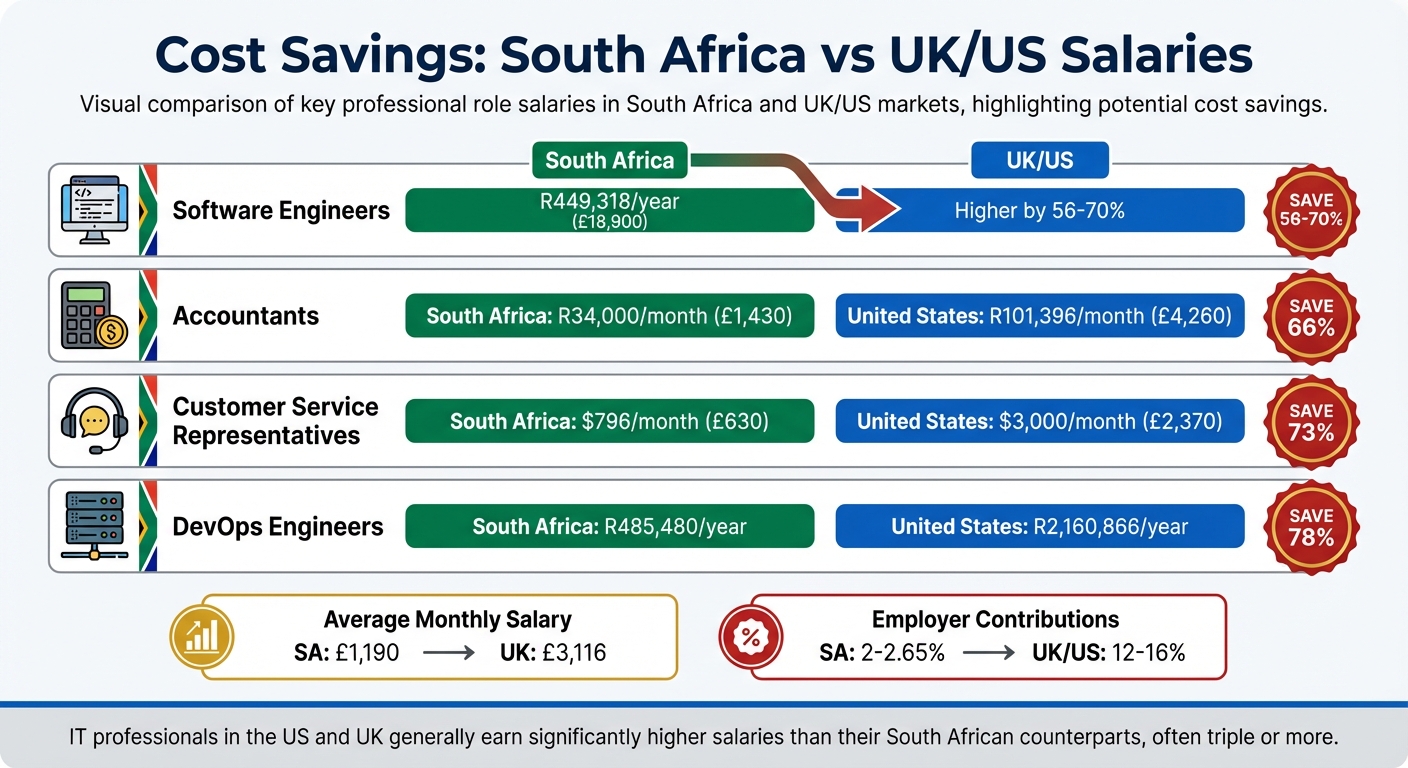
South Africa vs UK/US Salary Comparison for Key Roles
Salary Benchmarks and Employment Costs
Hiring talent in South Africa offers a noticeable cost advantage, especially when comparing salary benchmarks across various professional roles. For instance, software engineers in South Africa earn an average annual salary of R449,318 (around £18,900), which translates to savings of 56% to 70% compared to their counterparts in the UK and US markets. Similarly, accountants in South Africa typically earn R34,000 per month (approximately £1,430), whereas in the United States, the same role averages R101,396 monthly (roughly £4,260), a 66% saving. Customer service representatives in South Africa earn about $796 per month (around £630), compared to $3,000 (around £2,370) in the US. The contrast is even more striking for DevOps engineers, who earn R485,480 annually in South Africa, compared to R2,160,866 in the United States.
"IT professionals in the US and UK generally earn significantly higher salaries than their South African counterparts, often triple or more." – Melsoft Academy
These figures highlight the competitive edge of South Africa's workforce, offering businesses a chance to reduce costs without compromising on talent.
Beyond salaries, the overall employment costs in South Africa remain highly competitive. The average gross annual income is approximately R303,648, or R25,304 monthly (about £1,060). The national minimum wage, as of 1st March 2025, is set at R28.79 per hour. Additionally, businesses should account for the common practice of providing a 13th-month salary.
Tax Contributions and Employer Obligations
South Africa’s statutory employer contributions are another area where businesses can save. These typically range from 2% to 2.65% of gross salary, significantly lower than the 12% to 16% seen in the UK and US. This includes contributions to the Unemployment Insurance Fund (UIF), set at 1% of gross pay (capped at an annual salary of R212,544), and the Skills Development Levy (SDL), also at 1% of total payroll.
Smaller businesses with an annual payroll below R500,000 (approximately £21,000) are exempt from the SDL. Employers are also required to register for COIDA (Compensation for Occupational Injuries and Diseases Act), with rates typically around 0.5%, depending on the industry risk classification. While employers need to withhold Pay-As-You-Earn (PAYE) income tax on behalf of employees - ranging from 18% to 45% on a progressive scale - this does not add to the employer’s direct costs.
Employers must register with the South African Revenue Service (SARS) within 21 business days of hiring staff. Monthly submissions for PAYE, UIF, and SDL are due by the 7th of each month via the EMP201 form. Additionally, payroll records must be kept for at least five years to comply with South African regulations. These relatively low tax obligations make South Africa an attractive option for businesses looking to expand their workforce globally.
Key Skills and Industry Strengths
High-Demand Sectors
South Africa's workforce excels across several key industries, offering both cost advantages and a wealth of expertise. The Information and Communication Technology (ICT) sector is a standout, prioritised nationally and supported by a strong pool of specialists identified as critical skills. Similarly, engineering and technical trades provide the expertise needed for both domestic and international projects. In finance and commerce, Johannesburg shines as a major commercial hub, underpinned by advanced intellectual resources. The healthcare sector consistently produces professionals sought after on a global scale, while hospitality and tourism benefit from a workforce adept at delivering exceptional service to international clients.
Traditional strengths in mining and industrial operations continue to offer unparalleled expertise in large-scale ventures. Meanwhile, the agriculture sector successfully combines specialised knowledge with a robust labour force to maintain highly productive farmlands. Businesses aiming to recruit in these industries should consider Johannesburg for finance roles, Cape Town for tech opportunities, and Durban for industrial services. These industry strengths are bolstered by a diverse and highly capable workforce.
"South Africa ranks among the highest in Africa for English fluency, with many professionals demonstrating strong written and verbal communication skills." – Talent Sam
Workforce Demographics and Proficiency
South Africa's broad workforce demographics add to its global appeal, offering businesses access to one of the most diverse talent pools in the world. With a population exceeding 63 million people, the country is home to professionals known for their exceptional English proficiency. English is widely used as the primary language in business and professional training, ensuring clear communication and a strong grasp of industry-specific terminology. South Africa frequently ranks in the "Very High Proficiency" category on the EF English Proficiency Index.
This linguistic strength translates into tangible business benefits. For example, customer experience satisfaction levels in South Africa are 18% higher than those in other offshore markets. The country was also named the second-most favoured offshore CX delivery location globally in 2024. These achievements are deeply rooted in the Ubuntu philosophy, which emphasises teamwork and mutual respect, creating collaborative and harmonious workplaces.
South African professionals share workplace values with their UK counterparts, such as punctuality and professionalism. Additionally, the time zone alignment - just 1–2 hours ahead of the UK - enables seamless real-time collaboration. Together, these factors offer businesses not just cost savings but also access to a skilled, adaptable, and dependable workforce.
Hiring Models for International Businesses
For UK businesses exploring South Africa's cost-efficient workforce, there are three main hiring models to consider. These options depend on factors like team size, budget, and long-term market goals. Here’s a closer look at how you can establish a local workforce presence in South Africa.
Setting Up a Local Entity
Creating a local entity through the Companies and Intellectual Property Commission (CIPC) gives you full control over operations, employment terms, and company culture. Registration costs start at R125, or around R475 if you choose to reserve a unique business name. Annual compliance fees typically range between ZAR 50,000 and ZAR 100,000. The setup process, including tax registration with the South African Revenue Service (SARS), takes about 6 to 12 weeks.
This approach does, however, come with ongoing administrative responsibilities. These include monthly PAYE submissions, UIF contributions (1% of salaries), and the Skills Development Levy (1% for payrolls exceeding ZAR 500,000 annually). Registration with the Compensation Fund under COIDA is also required for workplace insurance. While the initial workload may seem heavy, this model becomes more cost-effective as your team grows beyond 15–20 full-time employees.
Employer of Record (EOR) Solutions
An Employer of Record (EOR) allows you to hire local talent without forming a legal entity. The EOR becomes the legal employer, but you retain control over daily operations. This approach significantly reduces setup time, enabling you to onboard employees in as little as 1–2 working days. The EOR handles all compliance matters, including registration with SARS, payroll processing, and adherence to the Basic Conditions of Employment Act.
For example, Platformics provides EOR services for £399 per month per employee. This fee covers HR administration, payroll, compliance, benefits coordination, and onboarding. The flat monthly cost simplifies budgeting and avoids the high upfront expenses of setting up an entity. This model is ideal for businesses looking to test the market, manage small remote teams, or hire quickly without taking on administrative burdens. However, using an EOR may influence corporate disclosures and benefits structures.
Engaging Contractors
Independent contractors offer a flexible solution for short-term or project-based work. This model requires minimal upfront investment and allows for quick engagement without the need for entity registration or EOR fees. However, there’s a risk of misclassification. If SARS determines that your contractors are being treated like full-time employees, you could face backdated PAYE, UIF, and SDL payments, along with penalties of up to 10% of outstanding amounts.
To avoid these risks, ensure contractors maintain independence. They should set their own schedules, use their own equipment, and work with multiple clients. If hiring workers earning below the 2025 threshold of ZAR 205,433.30 annually, fixed-term contracts must be clearly justified. It’s also essential to keep detailed payroll records for at least five years to comply with South African law.
| Feature | Local Entity | Employer of Record | Independent Contractor |
|---|---|---|---|
| Setup Time | 6–12 weeks | 1–2 days | Immediate |
| Upfront Cost | High | Low | Minimal |
| Compliance Risk | High | Low | High |
| Best For | Large teams (20+ employees) | Market testing / small teams | Short-term projects |
| Control Level | Full operational control | Operational control only | Limited control |
sbb-itb-9636a59
Compliance and Employment Regulations
The Basic Conditions of Employment Act (BCEA) sets the standard for employment practices in South Africa, covering aspects like working hours, leave, and employment contracts. For UK businesses operating in South Africa, compliance is non-negotiable. Failure to adhere to these regulations can lead to hefty fines and even criminal charges. For instance, late payroll tax submissions can result in penalties of up to 10% of the outstanding amount, while failing to deduct PAYE is a criminal offence that could lead to a prison sentence of up to two years.
Employment Contracts and Working Hours
Every employee must receive written employment details when they start their job. These details should include their job description, workplace location, wages, notice period, and leave entitlements. Working hours are capped at 45 hours per week, which typically translates to 9 hours a day over five days. Overtime is limited to 3 hours per day or 10 hours per week, must be agreed upon by the employee, and is paid at 1.5 times the regular rate. Work on Sundays or public holidays is compensated at double the normal pay rate.
From 1 April 2025, employees earning more than ZAR 261,748.45 annually will no longer be covered by certain BCEA provisions, such as those related to overtime and meal breaks. For those working night shifts between 18:00 and 06:00, employers are required to provide both a night shift allowance and transport. After five consecutive hours of work, employees are entitled to a one-hour meal break, though this can be reduced to 30 minutes by mutual agreement. Additionally, employers must display a statement of employee rights under the BCEA in the workplace, using the official languages spoken there.
Employee Benefits and Leave Entitlements
Beyond working hours and contracts, employee benefits form a critical part of compliance. Workers are entitled to 15 days of paid annual leave per year, calculated as one day for every 17 days worked. Sick leave is allotted as 30 paid days over a three-year cycle or one day for every 26 days worked during the first six months. Female employees are entitled to four months of unpaid maternity leave, with the option to claim up to 60% of their salary through the Unemployment Insurance Fund (UIF). Recent changes also allow both parents to share four months of parental leave. Employees with over four months of service can take four days of paid family responsibility leave annually, which can be used for events like a child’s illness or the death of a close family member.
While offering a 13th-month bonus is common, it’s not a legal requirement. If a business does offer this bonus, it should be clearly stated as discretionary in the employment contract. Employers must also register with the Compensation Fund under the Compensation for Occupational Injuries and Diseases Act (COIDA) to provide workplace insurance.
Tax Filing and Reporting Deadlines
Meeting tax deadlines is another essential aspect of compliance. Employers must submit monthly payroll tax (EMP201) by the 7th of each month and biannual EMP501 reconciliations by 31 May and 31 October. These submissions should be made electronically through eFiling or e@syFile™, using the unique 19-digit Payment Reference Number (PRN) for accurate allocation. Late submissions of EMP201 incur a 10% penalty on the outstanding amount, while late EMP501 submissions attract a 1% penalty on the total PAYE liability for the year, increasing monthly up to a maximum of 10%. If a deadline falls on a weekend or public holiday, submissions and payments must be made by the last business day beforehand.
| Compliance Area | Form/Requirement | Deadline |
|---|---|---|
| Monthly Payroll Tax | EMP201 (PAYE, UIF, SDL) | 7th of every month |
| Annual Tax Reconciliation | EMP501 / IRP5 | 31 May |
| Interim Tax Reconciliation | EMP501 | 31 October |
| Corporate Income Tax | ITR14 | 12 months after Financial Year End |
| Compensation Fund | COIDA Return of Earnings (ROE) | April–May |
| VAT | VAT201 | 25th or last business day of the period |
Adhering to these deadlines and regulations not only ensures legal compliance but also helps businesses take full advantage of South Africa’s cost-effective workforce. Proper compliance safeguards financial stability and operational efficiency.
Using Platformics for Workforce Expansion

Business Services Overview
Platformics makes expanding into South Africa straightforward by leveraging the country’s affordable workforce and flexible hiring options. They handle the administrative complexities, allowing UK businesses to focus on growth. Through their Employer of Record (EOR) service, companies can legally hire South African employees in just 1–2 working days - skipping the usual 6–12 week setup process and avoiding hefty annual costs. For a flat fee of £399 per month per employee, Platformics acts as the legal employer, taking care of everything from drafting BCEA-compliant employment contracts to calculating net pay and managing statutory deductions like PAYE, UIF, and SDL.
Their payroll service, priced at £49 per month, ensures accurate salary calculations, tax withholdings, and timely submissions of required forms (EMP201 by the 7th of each month and EMP501 by 31 May and 31 October). This helps businesses avoid penalties while staying compliant. For companies looking to establish a permanent presence, Platformics offers a company formation service for £799, covering incorporation, tax registration, and legal support.
Additionally, Platformics facilitates work permits for £1,499, helping businesses meet Home Affairs' requirements for General Work Visas, Critical Skills Visas, and Intra-Company Transfers. This process typically adds about three days to onboarding. Their accounting service, costing £149 per month, handles bookkeeping, financial statements, and tax filings while ensuring compliance with the five-year payroll record retention rule.
These services integrate seamlessly with the hiring models discussed earlier, ensuring businesses remain compliant and efficient as they scale.
Cost-Efficient Scaling with Expert Support
Platformics’ approach to workforce expansion is not only comprehensive but also highly cost-effective. For UK companies exploring South African markets or managing smaller teams (under 15 employees), their EOR model is particularly appealing. As Agility EOR explains:
"Employer of Record services are the fastest and least expensive way to handle payroll, HR, and compliance work in South Africa".
With its flat monthly fee structure, Platformics eliminates surprise legal and consulting costs while also assuming compliance risks on behalf of the business.
The support team takes care of critical tasks such as Right to Work checks, detailed payslips (including gross pay, PAYE, UIF, SDL, and leave balances), and monitoring legislative updates. This streamlined system means businesses can scale without needing to invest in an internal HR department or navigate the complexities of SARS eFiling. If operations grow, companies can transition to establishing a local entity with ease, ensuring flexibility at every stage of their expansion journey.
Conclusion
For UK businesses, South Africa presents an appealing opportunity for international growth with minimal overheads. The country combines lower wage costs - employer social security contributions are just 2% of salary - with a skilled, English-speaking workforce, making it especially attractive to industries like technology, finance, and manufacturing. Operating in the GMT+2 time zone also facilitates smooth, real-time collaboration with European teams. On top of this, a straightforward tax system and a reliable legal framework contribute to a stable business environment.
In addition to these financial benefits, South Africa’s compliance standards ensure secure operations. To succeed, businesses must prioritise local compliance from the outset - registering with SARS and adhering to the BCEA and LRA are essential first steps. Jaime Watkins from Playroll highlights the importance of this approach:
"South Africa's payroll environment rewards consistency. Employers who take the time to understand the system – or who partner with a local expert – can run compliant, predictable payroll cycles".
For companies looking to simplify their entry into the market, Employer of Record (EOR) solutions offer a practical option. An EOR model allows businesses to quickly hire and onboard employees - often within 1–2 working days - without the need for complex setup processes or high upfront costs. This approach ensures full compliance while minimising administrative burdens.
Platformics further supports businesses with its transparent pricing and comprehensive services, making workforce expansion straightforward. From drafting BCEA-compliant contracts to handling monthly EMP201 filings by the 7th, their platform covers the essentials. They also assist with company formation, work permits, and accounting, enabling businesses to focus on growth rather than red tape.
Whether you're hiring your first employee in South Africa or scaling a larger team, the country’s cost-effective and talented workforce offers a clear advantage. By tapping into South Africa’s affordability, skilled labour, and streamlined compliance processes, UK businesses can expand their operations with confidence and speed.
FAQs
What are the key benefits of hiring talent in South Africa compared to the UK?
Hiring talent from South Africa offers UK businesses some clear benefits. One of the most compelling is the lower labour costs. Employer contributions in South Africa average around 7.1% of an employee's salary, a sharp contrast to the UK’s 12–13% for National Insurance, pensions, and other statutory obligations. This difference allows companies to save significantly while tapping into a skilled, English-speaking workforce across sectors such as technology, finance, and engineering.
South Africa’s time zone (UTC+2) is another advantage, as it aligns closely with UK working hours, making real-time collaboration straightforward. The country also boasts a strong legal framework that ensures fair employment practices and provides solid protections for both employers and employees, offering peace of mind when it comes to compliance and resolving disputes. Combined with its shared cultural nuances, convenient location, and cost-effective talent pool, South Africa stands out as a smart choice for UK businesses aiming to expand or scale efficiently.
What is the Employer of Record (EOR) model, and how does it work in South Africa?
The Employer of Record (EOR) model allows a third-party provider to take on the role of the legal employer for a worker, while the hiring company retains control over the employee’s day-to-day responsibilities and performance. In South Africa, this means the EOR handles all legal and administrative employment tasks. These include issuing contracts that comply with local regulations, registering employees for tax and Unemployment Insurance Fund (UIF) contributions, processing payroll in South African Rand (ZAR), and managing statutory benefits. For expatriate employees, the EOR also assists with work permit applications.
This model removes the need for businesses to set up a local subsidiary or legal entity, making it easier and faster to hire in South Africa while staying compliant. An EOR ensures that all employment practices align with local labour laws, such as the Basic Conditions of Employment Act and the Labour Relations Act. They also take care of critical processes like terminations and maintaining compliance records.
Platformics provides a full range of EOR services, helping UK-based companies tap into South Africa’s skilled and cost-efficient workforce. From managing payroll and tax compliance to securing work permits and ongoing monitoring, Platformics streamlines the process of employing in South Africa. They even present costs in GBP (e.g., £1,200 per month) and use UK-friendly date formats (e.g., 7 January 2026), making the experience seamless for UK businesses.
What employment regulations should UK businesses know when hiring in South Africa?
UK businesses looking to hire in South Africa need to navigate local employment laws, which are primarily dictated by the Basic Conditions of Employment Act (BCEA) and the Labour Relations Act (LRA). These regulations govern crucial aspects such as employment contracts, working hours, overtime, leave entitlements, and procedures for termination. On top of that, employers must handle payroll obligations, including PAYE tax, contributions to the Unemployment Insurance Fund (UIF), the Skills Development Levy (SDL), and workers’ compensation under the Compensation for Occupational Injuries and Diseases Act.
To operate legally, employers must register with the Companies and Intellectual Property Commission (CIPC) to set up a local entity, as well as with the South African Revenue Service (SARS) to ensure compliance with tax and payroll regulations. Failure to comply can result in fines, penalties, or even disputes with trade unions.
Platformics offers a practical solution for UK businesses, providing services like company formation, payroll management, and compliance monitoring. These services help businesses meet South Africa's regulatory requirements with ease.
Related Blog Posts

Lavonne Nolan

Categories



.jpg)
