

How to Structure Taxes for Business Efficiency
Tax structuring is more than just compliance - it helps businesses manage costs, improve cash flow, and access tax incentives. In South Africa, understanding the available tax regimes and leveraging deductions can significantly reduce liabilities. Here's a quick breakdown:
Step 1: South Africa's Tax System Basics
Corporate Tax Rates and VAT
South Africa operates on a residence-based tax system, which means that companies registered in the country are taxed on their worldwide income. In contrast, non-resident companies are only taxed on income sourced within South Africa and capital gains from local property. The corporate income tax rate stands at 27% for assessment years ending between 1 April 2024 and 31 March 2026. This rate applies to most established businesses operating within the country.
The Value-Added Tax (VAT) rate is currently set at 15%, applying to the domestic consumption of goods and services, as well as imports. However, businesses should anticipate an increase to 16% by April 2026, a change that will likely impact pricing strategies and cash flow management, particularly for businesses handling large volumes of taxable supplies. VAT registration is mandatory when taxable supplies exceed R1 million within a 12-month period, though businesses with supplies exceeding R50,000 may register voluntarily.
In addition to these primary tax rates, companies face other levies. Dividends are taxed at 20%, while capital gains for companies are effectively taxed at 21.6%, as 80% of gains are included in taxable income. Employers are required to contribute 1% of their payroll to the Skills Development Levy if their annual payroll exceeds R500,000. Additionally, both employers and employees contribute 1% each to the Unemployment Insurance Fund.
Next, we’ll look at how global minimum tax rules influence multinational enterprises.
Global Minimum Tax Requirements
South Africa has adopted the 15% global minimum corporate tax for multinational enterprise (MNE) groups, effective for assessment years starting on or after 1 January 2024. This applies exclusively to MNE groups with annual consolidated revenue exceeding €750 million. The Minister of Finance confirmed the implementation of this minimum tax rate from 1 January 2024.
The system incorporates the Income Inclusion Rule (IIR), which taxes low-taxed foreign income earned by South African parent companies. Additionally, the Domestic Minimum Top-up Tax (DMTT) ensures that local entities meet the 15% minimum tax threshold. The National Treasury projects that this measure will expand the corporate income tax base by approximately R8 billion in the 2026/2027 fiscal year. As part of these changes, SARS introduced a dedicated registration framework on 19 December 2025 for companies subject to the Global Anti-Base Erosion (GloBE) rules.
Step 2: Selecting Your Business Tax Structure

South Africa Business Tax Regimes Comparison Guide
In South Africa, businesses can choose from three tax regimes, each tailored to different turnover levels and company structures. Picking the right one can help reduce tax burdens and streamline administrative tasks. Your choice depends on factors like annual revenue, the type of business activities, and shareholder composition. Here's a breakdown of each option.
Turnover Tax for Small Businesses
Turnover Tax is designed for micro-businesses with annual revenue of R1 million or less. It simplifies tax by replacing multiple taxes - such as Income Tax, VAT (optional for businesses wanting to claim input tax credits), Provisional Tax, Capital Gains Tax, and Dividends Tax - with a single payment based on gross revenue. The rates are as follows:
"Turnover tax is a simplified system aimed at making it easier for micro businesses to meet their tax obligations".
Record-keeping under this regime is minimal, focusing on receipts, dividends, and assets or liabilities worth more than R10,000. However, businesses offering professional services - like consulting, accounting, or legal work - are generally excluded unless they meet specific employment rules.
For businesses that outgrow the micro-business threshold, the Small Business Corporation (SBC) tax regime provides a progressive structure based on taxable profit.
Small Business Corporation (SBC) Tax Rates
The SBC tax regime is available to businesses with annual turnover between R1 million and R20 million. It offers a progressive tax structure based on taxable income (profit), which can lead to significant savings. For the 2025/2026 tax year, the rates are:
To qualify, the business must be a close corporation, cooperative, or private company where all shareholders are natural persons. If even one share is owned by a trust or another company, SBC eligibility is lost, and the business must pay the standard corporate tax rate. Additionally, investment income and income from personal services must not exceed 20% of the company’s total gross income.
Manufacturing SBCs enjoy added benefits, such as accelerated depreciation. They can write off 100% of the cost of plant and machinery in the year the asset is first used.
Standard Corporate Tax for Larger Businesses
Businesses with turnover exceeding R20 million - or those that don’t meet SBC criteria - fall under the standard corporate tax regime. This regime imposes a flat corporate income tax rate of 27% on all taxable income. The rate applies from the first rand of profit and is fixed for assessment years ending between 1 April 2025 and 31 March 2026.
For businesses nearing the R1 million or R20 million turnover thresholds, it’s essential to prepare for the "cliff effect." This occurs when crossing these thresholds results in a sudden increase in tax obligations and compliance requirements, including potential mandatory VAT registration.
Step 3: Using Deductions and Incentives
Once you've settled on a tax structure, the next step is to make the most of deductions and incentives to cut down your tax liability. South Africa's tax system provides a variety of ways to reduce taxable income, such as asset depreciation, payroll benefits, and retirement contributions. Knowing how to use these options can help improve cash flow and boost overall business efficiency.
Asset Depreciation and Capital Allowances
Asset depreciation is a straightforward way to reduce your taxable income. You can claim wear and tear allowances on assets used in your business, like equipment, vehicles, and machinery. SARS provides guidelines on write-off periods for different asset types. Depending on your strategy, you can opt for either the straight-line or diminishing value method to depreciate assets over their specified lifespan.
For smaller assets costing less than R7,000 and operating independently, you can write off the full amount in the year of purchase. This not only simplifies record-keeping but also provides immediate tax relief. If you're in manufacturing, there's an added bonus: new and unused machinery qualifies for accelerated depreciation - 40% in the first year and 20% annually for the following three years.
If you've invested in renewable energy projects, the Renewable Energy Allowance under Section 12BA offers a 125% deduction for assets brought into use between 1 March 2023 and 28 February 2025. Solar panels and similar investments made before the deadline are eligible for this enhanced deduction.
Businesses in Urban Development Zones (UDZ) can also benefit from accelerated depreciation. For building improvements, you can claim 20% per year, while new constructions allow for 20% in the first year, followed by 8% annually over the next ten years. The current sunset date is 31 March 2025, with a proposed extension to 31 March 2030. If your business operates in a UDZ, check if your premises qualify.
"Asset depreciation is an easy way to reduce your tax bill." – Jasper Basson
Keep detailed records of all asset purchases, including receipts and agreements, for at least five years. If you sell an asset for more than its tax-deductible value, the "recouped" amount will be treated as taxable income. Also, note that assets funded through government grants cannot be depreciated.
On top of asset deductions, payroll management is another area to explore for tax efficiency.
Payroll Compliance and Tax Benefits
Managing payroll effectively ensures compliance and opens the door to tax savings. The Employment Tax Incentive (ETI) is designed to encourage hiring young workers aged 18–29 earning less than R7,500 per month. Employers can claim 60% of monthly remuneration (up to R2,499) for the first 12 months, or R1,500 for those earning between R2,500 and R5,499. In the second 12 months, the claim reduces to 30% and R750 respectively.
"The employment tax incentive is aimed at encouraging employers to hire young and less experienced work seekers." – South African Revenue Service
To qualify for ETI, you must be registered for PAYE with SARS, stay tax-compliant, and ensure employees have valid South African ID or refugee documents. Any unclaimed ETI must be used by the end of the PAYE reconciliation period (August or February), or it will be forfeited. If your ETI exceeds your PAYE for the month, the excess rolls over to the next month within the same period.
Employers should also apply statutory tax rebates when calculating PAYE. For the 2025/2026 tax year, the primary rebate is R17,235, helping to determine accurate PAYE deductions. Additionally, the Medical Scheme Fees Tax Credit offers R364 per month for the taxpayer and their first dependent, and R246 for each additional dependent.
Using SARS-compliant payroll software, like Platformics Payroll, can simplify these processes and reduce the risk of errors. Mistakes could lead to missed incentives or issues during audits.
Retirement Contributions and Tax-Saving Options
Retirement planning is another effective way to optimise your tax position. Contributions to registered pension, provident, or retirement annuity funds are tax-deductible, subject to certain limits. This not only lowers taxable income but also helps employees save for retirement. Employers can structure pay packages to include retirement contributions, creating benefits for both sides.
Businesses can also deduct donations to approved public benefit organisations (PBOs), up to 10% of taxable income. This allows you to support charitable causes while reducing your tax bill.
For start-ups, pre-trade expenses are deductible in the year trade begins, although these are ring-fenced against income from the same trade. This can help offset some of the initial costs during your first year of operations. Additionally, learnership agreements entered into before 1 April 2024 qualify for extra tax deductions.
Lastly, note that for tax years ending on or after 31 March 2023, the set-off of assessed losses carried forward is capped at the higher of R1 million or 80% of taxable income. This limit affects how quickly you can offset accumulated losses against future profits.
sbb-itb-9636a59
Step 4: Meeting SARS and Global Tax Requirements
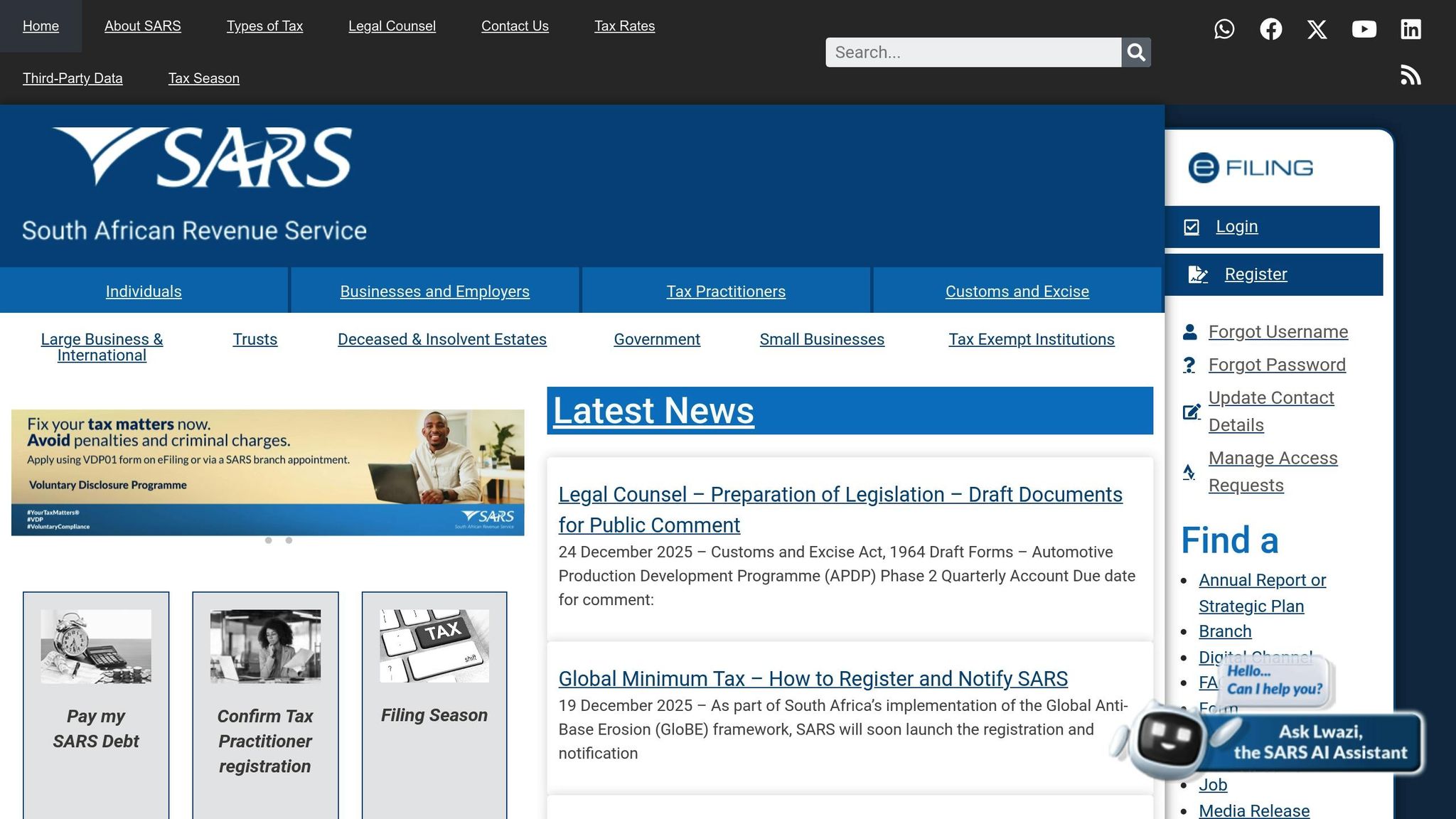
Once you've streamlined your deductions, the next step is ensuring your tax structure complies with SARS and international tax standards. Staying on top of registration, accurate filings, and audit preparations helps you avoid unnecessary penalties. For multinational businesses, understanding global minimum tax rules is just as crucial. Here's a closer look at the key processes, from VAT registration to managing global tax obligations.
VAT Registration and Filing
In South Africa, VAT registration is mandatory once your taxable supplies exceed R1 million in any 12-month period. However, you can also register voluntarily if your taxable supplies surpassed R50,000 in the past year or R4,200 in a single month.
The registration process can be completed via SARS eFiling or through a virtual appointment. Once you apply, SARS may issue a "Registration Application Review Notice", requesting supporting documents such as bank statements and financial records. These must be submitted within 21 business days. After registering, ensure you retain all relevant documents for at least five years to prepare for potential audits. For compulsory registrations, eFiling allows backdating up to six months, but anything beyond that requires an in-person visit to a SARS branch.
This VAT threshold also applies to electronic service providers operating outside South Africa but earning income within the country. Regularly monitor your South African revenue to avoid missing registration deadlines.
Preparing for SARS Audits
SARS audits can vary in duration, but once notified, you must submit the required documents electronically within the specified deadlines. Missing these deadlines could lead to SARS issuing an estimated assessment, which often results in higher tax liabilities. SARS is required to provide progress updates every 90 calendar days from the date of notification.
"SARS can levy penalties if we find that you have understated the amount of tax you owe. A penalty can be up to 200% of the shortfall." – South African Revenue Service
All documents must be uploaded via SARS eFiling in approved formats, with each file size limited to 5MB. If SARS identifies discrepancies, you'll receive an "Audit Findings Letter" and have at least 21 business days to respond with supporting evidence. Partnering with professional accounting services, such as Platformics Accounting, can help ensure your records are well-organised and audit-ready, reducing the risk of errors and penalties.
Managing International Tax Obligations
For multinational businesses, local compliance isn't the only concern - you'll also need to meet international tax standards. Companies with annual revenues exceeding €750 million must comply with the Global Minimum Tax rule, which sets an effective tax rate of at least 15%. South Africa has adopted the Global Anti-Base Erosion (GloBE) framework, with SARS introducing a registration system for this in late 2025.
"Implementing the global minimum tax will bolster South Africa's corporate income tax base by approximately 8 billion South African Rand (ZAR8b) in 2026/2027." – South African National Treasury
Additionally, businesses must disclose certain international tax structures to SARS. Starting 31 May 2025, all "Reportable Arrangements" must be submitted via eFiling, as manual email submissions will no longer be accepted. Ensure your eFiling profile has the "Reportable Arrangement" section activated to meet this requirement on time.
For foreign-sourced tax payments, use the Swift payment method to stay compliant with SARS regulations. If you encounter double taxation issues, refer to SARS' "Guide on Mutual Agreement Procedures" (MAP) for help in resolving disputes involving other jurisdictions. This guide can be an invaluable resource for navigating complex international tax challenges.
Step 5: Working with Tax Professionals
Once compliance is in place, the next decision is whether to handle tax obligations internally or bring in experts. By building on well-crafted tax strategies, working with professionals can turn compliance from a routine task into a tool for growth. In South Africa, many businesses find that outsourcing accounting and payroll not only reduces administrative workload but also ensures precision. In fact, over 40% of companies already outsource payroll functions, and this trend is growing as regulations become increasingly intricate.
Tax professionals are invaluable when it comes to navigating complex provisional tax estimates and forecasting. For example, businesses with taxable income exceeding R1 million must ensure their second provisional tax estimate is at least 80% of the actual taxable income to avoid a 20% penalty for under-estimation. Specialists also manage "trust taxes" like PAYE and UIF, which are state funds. Misusing these funds for business cash flow violates fiduciary duties, and directors can be held personally accountable for such breaches. Their expertise aligns seamlessly with outsourced services and strategic tax planning.
Outsourcing Accounting and Payroll
Opting for services like Platformics Accounting (£109/month) and Platformics Payroll (£36/month) ensures timely submission of critical filings, including the Company Income Tax Return (ITR14), monthly EMP201 filings, and VAT returns. Avoiding late submissions helps businesses steer clear of automated SARS penalties. These providers leverage cloud technology and automation, offering real-time updates while minimising manual errors and fraud risks.
Outsourcing also frees up resources for more strategic initiatives. Companies gain access to CA(SA)-led expertise and registered tax practitioners without the expense of hiring a full-time senior staff member. Payroll records, which must include details like taxes, deductions, and salaries, are legally required to be stored for at least three years, even after employees leave. Specialists ensure this obligation is met effortlessly, keeping businesses audit-ready.
Including Tax Planning in Business Strategy
Year-end tax planning plays a crucial role in managing cash flow and avoiding penalties. For instance, asset deductions can help optimise tax liabilities, but these benefits are only fully realised with proactive planning. Tax professionals rely on up-to-date management accounts, not outdated data, to accurately forecast provisional tax payments. They can also guide businesses on making a voluntary third provisional payment, which allows any remaining tax liabilities to be settled within seven months of the financial year-end, helping to avoid interest charges.
Strategic planning also includes making the most of incentives like the Employment Tax Incentive (ETI), available until 28 February 2029, and Section 12H learnership allowances. Tax experts coordinate Annual Financial Statements (AFS), CIPC returns, and SARS filings to avoid penalties. They also calculate your Public Interest Score (PIS), which determines whether a business requires a full external audit or an independent review.
Complete Business Solutions with Platformics

By integrating professional services, Platformics simplifies tax management for businesses operating in South Africa. Their end-to-end solutions cover not just accounting and payroll but also company formation (starting at £585), employer of record services (from £292/month), work permits, and software and banking solutions. This all-in-one approach centralises compliance, HR, and financial reporting under a single provider.
For businesses dealing with VAT registration thresholds, international tax obligations, or SARS audits, Platformics offers dedicated expert support. The platform ensures that all tax types - VAT, PAYE, and CIT - are correctly activated on eFiling, and that your Registered Representative (Public Officer) is formally appointed with SARS. This eliminates the hassle of juggling multiple service providers while ensuring full compliance with South African tax laws.
Conclusion
The strategies mentioned earlier highlight how a well-designed tax structure can do more than just ensure compliance - it can actively enhance business efficiency. Streamlined company setup processes not only simplify tax compliance but also create a strong operational foundation. Choosing the right tax regime - whether it’s Turnover Tax, SBC, or standard corporate tax - has a direct influence on cash flow and long-term growth potential.
A forward-thinking, cohesive tax strategy turns compliance into an opportunity for growth. By making timely provisional tax payments and taking advantage of available incentives, such as the 125% Section 12BA deduction, businesses can recover capital faster and avoid penalties.
As EY South Africa aptly puts it:
"Careful tax planning is critical for business success in an unpredictable global economy".
Incorporating tax strategy into broader business decisions maximises its potential benefits. Professional expertise becomes especially valuable when dealing with SARS audits or navigating complex cross-border tax obligations.
For South African businesses, Platformics offers a comprehensive solution by integrating tax and compliance needs into one seamless platform. From company formation services (starting at £585) to ongoing accounting support (£109/month) and payroll management (£36/month), Platformics ensures businesses remain compliant while freeing up time and resources for strategic growth. With SARS moving towards eFiling and global minimum tax rules set to roll out in late 2025, having dedicated expert support is more critical than ever. Aligning tax planning with overall business objectives gives companies a clear edge in an ever-changing market.
Related Blog Posts
- South Africa Tax Compliance Checklist for Businesses
- High Labor Costs? South Africa Expansion Solutions
- 5 Ways to Cut Payroll Costs in South Africa
- Company Formation South Africa: 6 Essential Steps

Lavonne Nolan

Categories



.jpg)
