
How to Choose a Business Structure in South Africa
Picking the right business structure is one of the first and most important decisions when starting a business in South Africa. Your choice will affect personal liability, tax responsibilities, and how easily you can secure funding or scale your business. Here's a quick breakdown of the main options:
- Sole Proprietorship: Simple to set up but carries unlimited personal liability. Ideal for low-risk, solo ventures.
- Partnership: Combines resources but involves shared liability. Suited for professional services.
- Private Company (Pty Ltd): Offers limited liability and is great for businesses seeking investment or growth.
- Public Company (Ltd): Designed for large-scale businesses and can list on the JSE, but requires higher compliance.
- Non-Profit Company (NPC): Focused on public benefit with potential tax relief if registered as a Public Benefit Organisation.
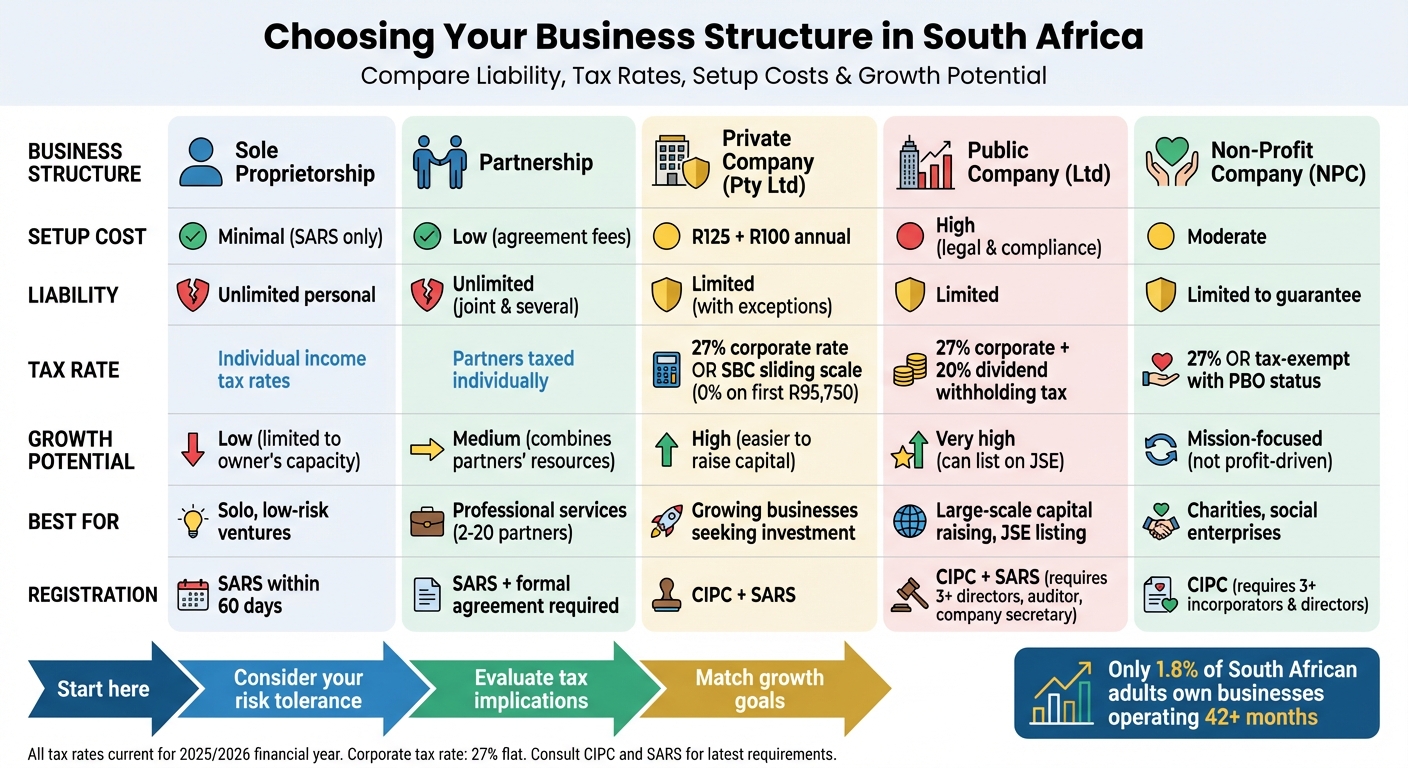
Each structure has unique tax rates, liability levels, and growth potential. For example, sole proprietors are taxed at personal income rates, while companies pay a flat 27% corporate tax. Partnerships require formal agreements to manage risks, and public companies face stricter regulations but allow for large-scale funding through share sales.
To register, you'll need to go through the Companies and Intellectual Property Commission (CIPC) and handle tax registration with SARS. Services like Platformics can simplify this process.
Key Takeaway: Match your structure to your goals, liability comfort, and tax preferences. Make an informed choice to avoid restructuring later.
South Africa Business Structure Comparison: Liability, Tax & Growth
Business Structures In South Africa Explained | Sole Proprietor To Non-Profit (2025 Guide)
What to Consider When Choosing a Business Structure
Your choice of business structure shapes your financial exposure, tax responsibilities, and potential for growth. To make an informed decision, focus on three key aspects: liability protection, tax obligations, and the ability to secure funding.
Liability Protection
The level of personal risk you're willing to accept is a crucial factor when deciding on a business structure. In sole proprietorships and partnerships, there’s no separation between your personal and business assets. As SARS explains, "The proprietor assumes the risks of the business to the extent of all of his or her assets whether used in the business or not". This means creditors can claim your personal assets to settle business debts.
Partnerships come with an extra layer of risk: joint and several liability. According to SARS, "one partner who is not exercising sound judgment could cause the loss of the assets of the partnership as well as the personal assets of all the partners". Even if you manage your business responsibly, you could still be held accountable for a partner’s poor decisions.
Private companies (Pty Ltd) offer a layer of protection by limiting liability to your investment. If the business fails, your personal assets are generally safe. However, this protection isn’t absolute. Under the Companies Act 71 of 2008, individuals who knowingly engage in reckless or fraudulent business practices can be held personally liable for the company’s debts. Directors may also face personal liability for unpaid VAT and employees' tax (PAYE) if the company fails to meet its SARS obligations.
While liability is a major concern, tax treatment also plays a significant role in choosing the right structure.
Tax Implications
Taxation varies significantly across business structures and directly impacts your bottom line. Sole proprietors and partners are taxed on business profits at individual income tax rates. In contrast, private companies and close corporations are taxed separately at a flat 27% corporate income tax rate for financial years ending between 1 April 2025 and 31 March 2026. Small Business Corporations (SBCs) enjoy preferential rates, with the first R95,750 of taxable income taxed at 0%.
For small enterprises with low turnover, the turnover tax system simplifies matters by taxing revenue instead of profit, easing administrative burdens. Before settling on a structure, check if you qualify for these incentives - they could significantly reduce your tax and compliance costs.
Beyond tax considerations, think about how your structure aligns with your funding and growth goals.
Capital Requirements and Growth Potential
Your structure should support both your current funding needs and future expansion plans. Private companies (Pty Ltd) are often favoured for their ability to attract funding. Their separate legal status and continuity make them appealing to investors and lenders.
Public companies (Ltd) offer the greatest potential for growth. They’re the only entities allowed to list on the Johannesburg Securities Exchange (JSE) and can raise capital by offering shares to the public. However, they require at least three directors and must comply with stricter regulations.
On the other hand, sole proprietorships and partnerships may face challenges in securing long-term funding. Without a separate legal personality, they rely heavily on the personal creditworthiness of the owner or partners.
| Structure | Liability Level | Tax Treatment | Growth Potential |
|---|---|---|---|
| Sole Proprietorship | Unlimited personal liability | Individual income tax rates | Low; limited to the owner's capacity |
| Partnership | Unlimited; joint and several | Partners taxed individually | Medium; combines partners' resources |
| Private Company (Pty Ltd) | Limited (with exceptions) | 27% corporate rate or SBC rates | High; easier to raise capital |
| Public Company (Ltd) | Limited | 27% corporate rate | Very high; can list on JSE |
Business Structure Options in South Africa
When starting a business in South Africa, selecting the right structure is crucial. Each option comes with its own balance of risk, tax obligations, and growth potential. Your decision will impact everything from administrative requirements to how much personal liability you carry.
Private Company (Pty) Ltd
A Private Company is a popular choice for entrepreneurs planning to scale beyond a solo operation. Its main advantage? Limited liability, which means your personal assets are generally safe if the business faces financial trouble - provided there’s no reckless or fraudulent conduct.
To set up a Private Company, you’ll need to register with the Companies and Intellectual Property Commission (CIPC) for R125 and file annual returns costing R100. This structure also allows for perpetual succession, making it easier to attract investors or secure loans. Tax-wise, companies are subject to a flat corporate tax rate of 27%, and Small Business Corporations with turnover under R20 million may benefit from a sliding tax scale.
However, these benefits come with added responsibilities. You’ll need to maintain accurate financial records, file annual returns, and, depending on your public interest score, possibly undergo audits.
Sole Proprietorship
If you’re running a solo operation, a sole proprietorship offers a straightforward and low-cost setup. There’s no need to register with the CIPC; instead, you simply register with SARS for tax purposes within 60 days of starting your business. Profits are taxed at personal income tax rates.
But simplicity comes with a catch. As Nedbank highlights:
"A sole proprietorship provides no legal liability protection to you as the owner. Your personal assets could be seized and sold in any debt recovery claims".
This lack of separation between the business and its owner makes it best suited for low-risk ventures, such as freelance work or small-scale retail.
Public Company (Ltd)
Public Companies are built for businesses with large-scale ambitions. They’re the only type of entity allowed to sell shares to the public and list on the Johannesburg Securities Exchange (JSE). This structure is ideal for raising substantial capital.
However, it comes with strict governance requirements. You’ll need at least three directors, a company secretary, and a designated auditor. Annual General Meetings and detailed financial audits are mandatory. Shareholders face a 27% corporate tax rate, plus a 20% withholding tax on dividends.
Given the high compliance costs and regulatory demands, Public Companies are typically reserved for well-established businesses aiming for significant growth.
Partnership
Partnerships are a good fit for professional services where two to 20 people want to combine resources and expertise. They’re relatively easy to set up and offer flexibility in how profits are split.
However, partnerships come with unlimited liability. Each partner is jointly and severally liable for the actions of the others, so a formal partnership agreement is vital. This document should outline contributions, profit-sharing arrangements, and dispute resolution procedures.
Partners are taxed individually on their share of the profits at personal income tax rates, though the partnership itself doesn’t pay tax. Registration with SARS is still required, and unless otherwise stated in the partnership agreement, the structure dissolves if a partner leaves or passes away.
Non-Profit Company (NPC)
Non-Profit Companies are tailored for organisations focused on public benefit rather than profit. Charities, educational initiatives, and social enterprises often choose this structure. At least three incorporators and three directors are required, and profits must be reinvested into the organisation’s mission.
One big perk is potential tax relief. By applying for Public Benefit Organisation (PBO) status with SARS, NPCs may gain exemptions from income tax, donations tax, and dividend tax. Without PBO status, they’re taxed at the standard 27% corporate rate.
As Frank Grozel from UNCTAD notes:
"Non-profits in Africa thrive when they combine strong governance with digital transparency. Organisations that clearly show how funds are used build donor trust".
However, maintaining tax-exempt status requires detailed reporting and strong governance practices.
| Structure | Setup Cost | Liability | Best For |
|---|---|---|---|
| Sole Proprietorship | Minimal (SARS only) | Unlimited personal | Solo, low-risk ventures |
| Partnership | Low (agreement fees) | Unlimited (joint & several) | Professional services (2–20 partners) |
| Private Company (Pty) Ltd | R125 + R100 annual | Limited (with exceptions) | Growing businesses seeking investment |
| Public Company (Ltd) | High (legal & compliance) | Limited | Large-scale capital raising, JSE listing |
| Non-Profit Company (NPC) | Moderate | Limited to guarantee | Charities, social enterprises |
sbb-itb-9636a59
How to Register Your Business in South Africa
Once you’ve decided on your business structure, the next steps involve registering with the Companies and Intellectual Property Commission (CIPC) and sorting out tax registration with the South African Revenue Service (SARS). The good news? Most of this can be done online, and some parts happen automatically.
Name Reservation and Registration with CIPC
First, you’ll need to secure a name for your business. Alternatively, you can register using your enterprise number (e.g., K2025123456) as your official name. If you want a specific name, submit up to four options via the CIPC e-Services portal, BizPortal, or the mobile app. This increases your chances of approval since many names might already be taken. Typically, digital name reservations are processed within one working day.
Once your name is approved, you’ll need to prepare the following documents:
- Notice of Incorporation (Form CoR 14.1)
- Memorandum of Incorporation (MOI) using the CIPC template
- Certified ID or passport copies for all directors
Next, pay the registration fees within five days of submission. Registering a Private Company (Pty) Ltd costs R125, or R175 if you’re also reserving a name.
For small businesses, BizPortal is often the quickest and easiest way to register. It allows you to handle additional registrations, such as a B‑BBBEE certificate, Compensation Fund, and UIF, all at no extra charge. If you use BizPortal, the CIPC mobile app, or partner banks like ABSA, FNB, or Nedbank, your company can sometimes be registered instantly if payments clear immediately. Once your registration is approved, download your Certificate of Incorporation (CoR14.3) and MOI documents. These are free to access for the first 30 days.
Tax Registration with SARS
After registering with the CIPC, SARS automatically issues an Income Tax reference number for your business. You’ll need to complete your eFiling registration within 60 business days.
If you plan to employ staff for more than 24 hours a month, you’ll also need to register for PAYE, UIF, and the Skills Development Levy (SDL). Additionally, opening a business bank account is essential to keep your financial records organised. This is especially helpful if you ever apply for loans or funding.
If you’re unsure about any part of the process, there are experts who can guide you through these steps.
Using Platformics for Company Formation

For a hassle-free experience, Platformics offers an all-in-one service for £630 ($799). They handle everything from name reservations and CIPC registration to mandatory tax registrations with SARS. They also provide ongoing compliance management and expert support to ensure you meet all legal requirements without dealing with the paperwork yourself. This service is particularly useful if you’re unfamiliar with South African regulations or want to focus on growing your business while someone else handles the administrative side.
Conclusion
Before making your final decision, take some time to evaluate your liability, tax obligations, and growth ambitions. The choice you make will directly impact your personal risk, ability to raise capital, and the potential for partnerships. For instance, a Private Company (Pty Ltd) provides limited liability protection and perpetual succession, but it does come with higher compliance costs and added administrative duties.
Currently, only 1.8% of South African adults aged 18–64 own and manage businesses that have been paying salaries for over 42 months. This statistic underscores the importance of establishing a solid foundation from the outset. As Standard Bank aptly notes: "Selecting the right business structure from the beginning will save you a lot of headaches later down the line".
Selecting a structure that aligns with your operational, financial, and growth strategies is essential. Once you’ve decided on the best fit, ensure you complete the necessary registrations with the CIPC and SARS. If you plan to hire staff, additional registrations for PAYE, UIF, and the Skills Development Levy will also be required.
For entrepreneurs who want to focus on growth rather than administrative tasks, Platformics offers a streamlined company formation service for £640. This package includes CIPC registration, SARS compliance, and ongoing administrative support.
Choose wisely - your business structure should be a stepping stone to achieving your long-term goals.
FAQs
What should I consider when deciding on a business structure in South Africa?
Choosing the right business structure in South Africa involves weighing several important factors:
- Liability: If you're a sole trader, you’re personally liable for any business debts. On the other hand, choosing a proprietary limited (Pty Ltd) company can shield your personal assets from business liabilities.
- Tax considerations: Different structures come with different tax obligations. For instance, some are taxed at corporate rates, while others pass profits directly to your personal income, which can affect both your cash flow and compliance requirements.
- Funding and partnerships: Pty Ltd companies have the advantage of being able to issue shares, making it easier to attract investors. In contrast, sole traders and partnerships often rely on personal funds or informal agreements for financing.
- Costs and compliance: Operating as a sole trader typically involves fewer registration and reporting requirements, keeping things straightforward. However, companies like Pty Ltds may face additional costs for annual returns, licences, and other compliance-related expenses.
- Future growth potential: Think long-term. Does the structure you’re considering allow for future expansion, the possibility of selling the business, or transferring ownership down the line?
If all of this sounds overwhelming, Platformics can help. They streamline the entire process - handling everything from registration to payroll and compliance - so you can focus on building your business in South Africa.
What are the liability differences between business structures in South Africa?
In South Africa, the level of liability a business owner faces hinges on whether the business operates as a separate legal entity or is directly linked to the owner. For example, in a sole proprietorship or partnership, the business is not a separate entity. This means the owner’s personal assets - like their home or savings - can be used to cover business debts, a situation known as unlimited personal liability.
On the other hand, structures such as a private company (Pty Ltd) or a public company (Ltd) are treated as separate legal entities. In these cases, shareholders enjoy limited liability, which means their financial responsibility is capped at the amount they’ve invested or any unpaid portion of their shares. However, it’s worth noting that directors of these companies can still be held personally liable for specific actions, such as failing to comply with tax laws or continuing to trade while the business is insolvent.
Selecting the right business structure is a critical decision, as it directly impacts the protection of your personal assets and how much financial risk you’re exposed to. For many entrepreneurs, opting for a limited liability structure provides a greater sense of financial security and reduces personal risk.
What are the tax obligations for different business structures in South Africa?
Choosing the right business structure in South Africa is a big decision since each option comes with its own tax responsibilities. Here's a breakdown of the main structures:
For a sole proprietorship, your profits are taxed as part of your personal income, based on individual marginal rates. You’ll also need to register for provisional tax and, if your turnover crosses the required threshold, VAT registration becomes necessary.
In a partnership, profits are divided among the partners and taxed at their respective personal income rates. While the partnership itself doesn’t pay tax, it must submit a tax return outlining how profits are allocated among the partners.
A private company operates as its own legal entity and pays corporate income tax at a flat rate of 28%. Directors or shareholders could be held personally responsible for unpaid taxes, including PAYE and VAT. Additionally, if dividends are distributed, shareholders must pay a 20% dividend tax.
Each structure comes with specific compliance requirements that need careful attention. Platformics can help simplify the process by offering expert assistance with company registration, tax compliance, and ongoing management - so you can focus on growing your business.
Related Blog Posts

Lavonne Nolan

Categories



.jpg)
